How Systems Thinking Solves Thinking Problems That Keep Coming Back
Have you ever noticed that certain problems just keep coming back?
You fix something at work, it's better for a while, then a few months later you're dealing with the same issue again. You set a personal goal, make real progress, then somehow find yourself right back where you started. You solve a customer complaint, implement changes, and then watch similar complaints resurface with slightly different details.
Here's the truth: You're not failing. You're solving symptoms while the hidden structure creating those symptoms remains completely untouched.
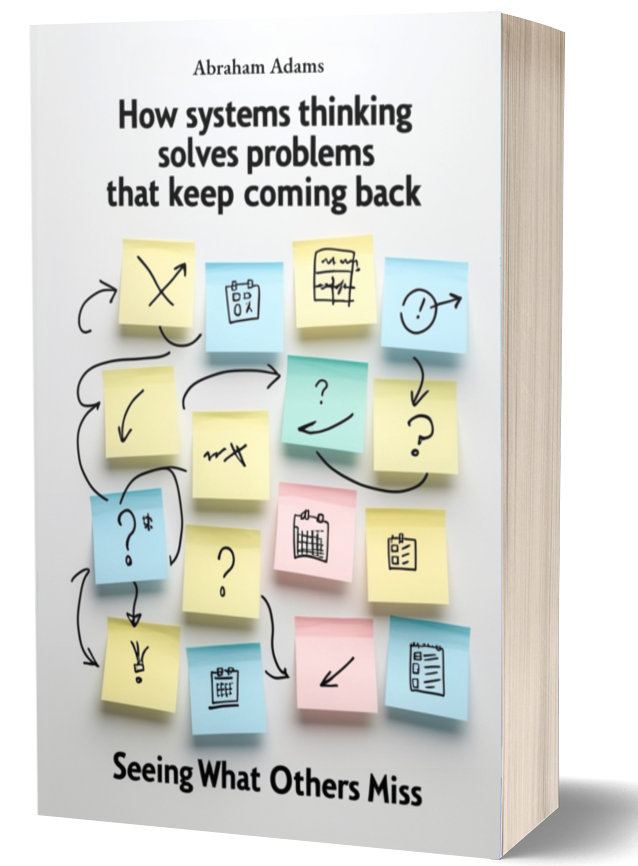
Welcome to How Systems Thinking Solves Problems That Keep Coming Back: Seeing What Others Miss.
My name is Abraham Adams, and I've spent years studying the invisible architecture that shapes outcomes in our businesses, organizations, and personal lives. What I've discovered is that most of us have been trained to see events and fix immediate causes. But the problems that matter—the ones that keep recurring—aren't caused by events. They're produced by systems.
Systems are everywhere. They're in your workplace, your relationships, your daily routines, your finances. They're networks of feedback loops, delays, incentives, and structures that reliably produce certain patterns—whether you see them or not.
And here's what changes everything: once you learn to see these systems, you can change them.
Let me give you an example. There's a manufacturing plant in this book that spent seventeen years solving the same quality problem over and over. Every few months, defect rates would spike. Management would spring into action—retrain workers, replace equipment, increase inspections. The defect rate would drop. Six months later, it would happen again.
They weren't incompetent. They were doing exactly what any reasonable person would do. But they were solving symptoms. When they finally traced the pattern upstream, they discovered the quality spikes happened exactly four months after every major promotional campaign. Big promotion meant rushed hiring, which meant inadequate training, which showed up as quality issues four months later when those new workers moved to complex tasks.
The quality problem wasn't a quality problem. It was a hiring and training problem triggered by marketing decisions, delayed by the time it took for consequences to appear. Once they saw the system, the solution became obvious—and it actually worked.
That's what this book teaches you to do.
Here's what we'll cover together:
We'll start with five fundamental questions you can use immediately on any recurring problem in your life or work. These questions will help you recognize when you're looking at a pattern instead of an isolated event, and when you're pushing on symptoms instead of structure.
Then we'll go deeper into how systems actually work.
You'll learn to see the architecture beneath the surface—the hidden connections and feedback loops that make certain outcomes inevitable. You'll discover why your solutions so often become problems themselves, creating unintended consequences that make things worse. You'll understand why everything takes longer than you think, and how delays break the link between cause and effect, making you solve the wrong problems.
You'll learn the crucial difference between complicated and complex systems—and why bringing the wrong approach to a complex problem guarantees failure, even when you're smart and experienced.
We'll explore why systems resist change, and why that resistance is actually information about what matters in the system. Instead of fighting resistance with force, you'll learn to read it and work with it.
Perhaps most importantly, you'll discover where to actually intervene. Most people push hard on the most obvious places—adding more people, working longer hours, trying harder. These are almost always low-leverage points. I'll show you how to find the real leverage points, where small changes create disproportionate impact.
You'll learn when to act immediately and when strategic patience is wiser. How to change the rules you're playing by instead of just playing the game harder. And how to redesign your own life as a system—so the behavior you want becomes natural instead of requiring constant willpower.
Every concept is grounded in real stories. You'll hear about the credit union that had a thirty percent loan rejection rate for years without anyone deciding that should be the rate. The restaurant owner who kept pushing his kitchen to work faster and made everything slower. The hospital that dramatically improved patient safety not through better training but by putting hand sanitizer outside every room instead of requiring trips to sinks.
You'll meet leaders who transformed their organizations not by working harder but by seeing more clearly. People who solved personal patterns that had trapped them for years. Teams that stopped firefighting and started fixing the structures that created the fires.
By the end of this book, you'll be able to look at any recurring problem and see what's really creating it. You'll know where to intervene for maximum impact. You'll understand how to design systems—at work and in your life—that work with human nature instead of against it.
And you'll have practical tools. The book includes six templates you can use: for mapping patterns, detecting unintended consequences, redesigning structures, and maintaining your systems thinking practice over time.
This book is for anyone who's tired of solving the same problems repeatedly. Leaders and managers fighting organizational fires. Entrepreneurs whose problems scale with their business. Professionals drowning despite endless productivity optimization. Anyone frustrated by patterns they can't seem to break.
The systems are already there. They're running in the background of everything you do. They're shaping your outcomes, creating your recurring frustrations, making certain patterns inevitable.
You can't see them yet. But you will.
Once you learn to see systems, you can't unsee them. Problems that seemed random reveal their hidden structure. Challenges that felt personal show themselves as systemic. Solutions that seemed impossible become obvious.
You'll stop fighting against invisible forces and start working with them. You'll stop solving the same problems and start solving the structures that create them.
The question isn't whether systems are shaping your life. They are. The question is whether you'll learn to see them clearly enough to change them.
Let's begin seeing what others miss.