The Feedback Loops - Why Premiums Keep Rising
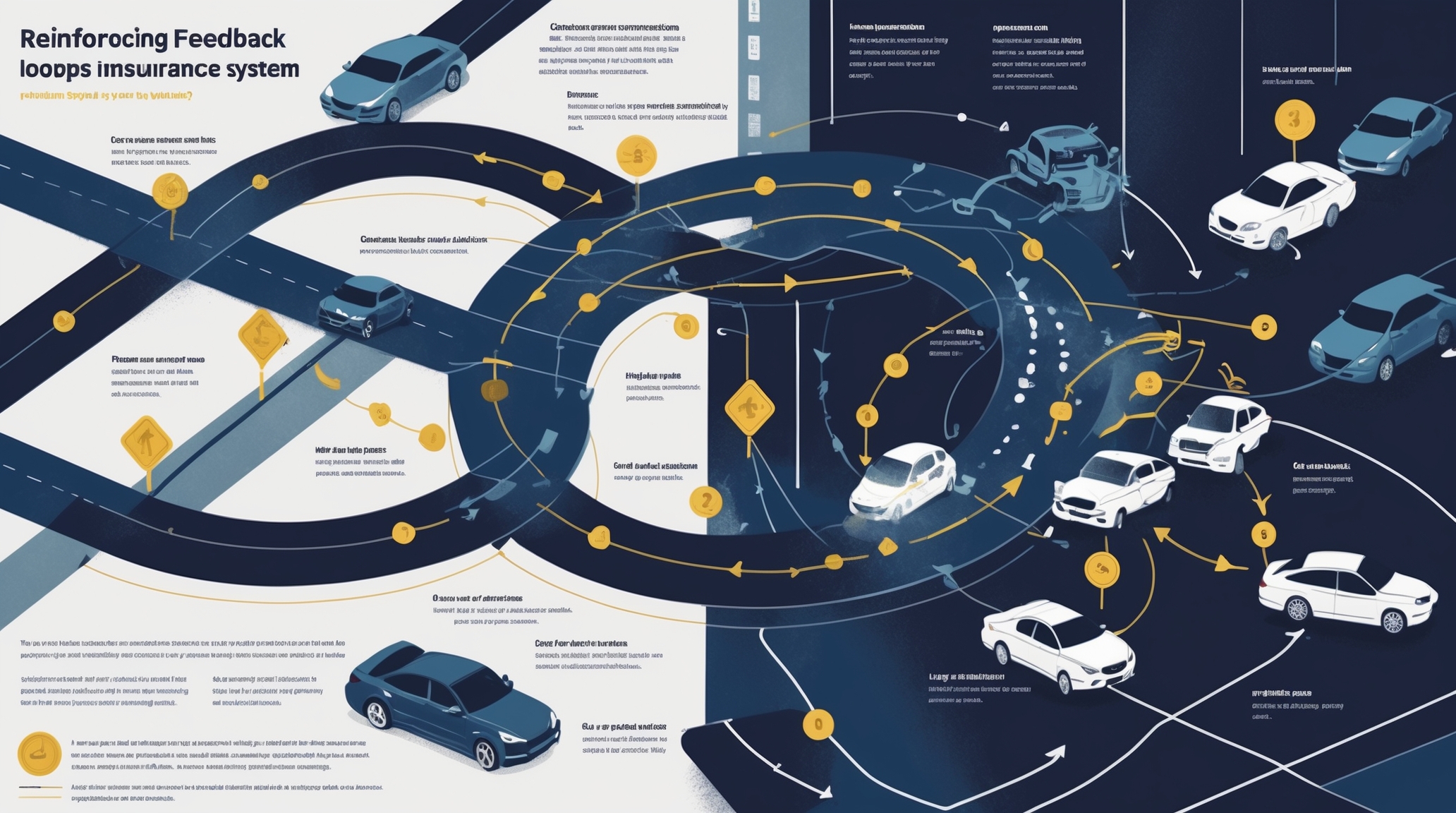
Car insurance premiums are supposed to reflect risk. If accident rates fall, if cars become safer, if fraud decreases, premiums should fall. That is the logic, the theory, the justification for how insurance pricing works. But premiums do not fall, they rise. Year after year, premiums increase, faster than inflation, faster than wages, and drivers pay more for the same coverage, for the same legal requirement, and the increases are relentless.
And this is not random, it is not accidental, it is the result of feedback loops, dynamics within the system that drive premiums upward regardless of underlying risk, regardless of claims costs, regardless of what is fair. These loops interact, reinforce each other, and together they ensure that premiums rise, that extraction accelerates, and that drivers, particularly young drivers and high-risk groups, pay more every year.
Let me show you the feedback loops that keep car insurance premiums rising.
The first loop is the claims inflation loop. When insurers pay out claims, the cost of those claims rises over time. Not because accidents are worse, not because cars are more damaged, but because the cost of everything involved in a claim increases. The cost of repairs rises, because garages charge more for labor, because parts cost more, because newer cars have more technology, more sensors, more electronics, all expensive to fix. The cost of personal injury claims rises, because compensation amounts increase, because legal costs increase, because the number of claims increases.
And here is the feedback. Higher claims costs mean insurers pay out more. Insurers, to maintain profit margins, raise premiums to cover the higher costs. Higher premiums generate more revenue. But higher premiums also create pressure for claims costs to rise further, because repairers, knowing insurers are collecting more in premiums, charge more for repairs. Lawyers, knowing insurers have more revenue, pursue higher compensation. And the loop continues, claims costs rise, premiums rise to cover them, and claims costs rise again because there is more money in the system.
And this loop is accelerated by fraud. Fraudulent claims, exaggerated injuries, staged accidents, all add to insurers' costs. And insurers, unable to distinguish every fraudulent claim from every genuine one, pay out on some fraudulent claims, and the cost is passed to all policyholders. And fraudsters, seeing that insurers pay out, are incentivized to make more claims, and fraud increases, and costs rise, and premiums rise, and the loop reinforces.
The second loop is the loyalty penalty loop. Insurers charge existing customers more than new customers. A driver who renews with the same insurer year after year sees their premium increase, often significantly, even if nothing about their risk has changed, even if they have not claimed. This is the loyalty penalty, and it is a deliberate pricing strategy designed to extract more from customers who do not switch.
And here is the feedback. Loyal customers, paying higher premiums, eventually realize they are being overcharged. They shop around, they switch to a cheaper insurer, attracted by new customer discounts. The original insurer loses the customer, loses the premium revenue. To replace that revenue, the insurer attracts new customers with low prices, subsidized by the loyalty penalties charged to remaining customers. So loyal customers subsidize new customer acquisition, and the more loyal customers leave, the higher the penalties on remaining customers must be to fund new customer discounts.
And this creates churn. Customers switch every year, hunting for the cheapest deal, and insurers lose and gain customers constantly. And churn is expensive, marketing costs, administration costs, comparison site fees for every new customer acquired. And these costs are built into premiums, so premiums rise to cover the cost of churn, and churn increases because premiums rise, and the loop continues.
And the loop punishes those who do not switch. Older customers, less tech-savvy, less aware of comparison sites, less willing to shop around every year, stay with the same insurer and pay loyalty penalties. And they subsidize the system, they pay higher premiums, and insurers profit from their inertia.
The third loop is the young driver poverty loop. Young drivers pay high premiums, often thousands of pounds, because they are statistically higher risk, because they have no claims history, because insurers segment by age and charge young drivers more. And high premiums create financial pressure, particularly for young people on low incomes, students, apprentices, those starting their first jobs.
And here is the feedback. High premiums are difficult to afford. Young drivers struggle to pay, they go into debt, they borrow from family, they use credit cards, they sacrifice other spending. And financial pressure means they cannot afford comprehensive cover, they buy the cheapest, most basic third-party insurance, which covers damage to others but not to their own car. And if they have an accident, if their car is damaged, they cannot afford to repair it, and they lose the car, and they cannot afford to replace it, and they lose the ability to drive, and they lose access to work, to education, to independence.
And losing access to work means lower income, means less ability to afford insurance in future, means remaining trapped in low-paid jobs accessible by public transport. And the loop reinforces, high premiums create poverty, poverty prevents building no-claims bonus, no bonus means continued high premiums, and young drivers remain stuck.
And some young drivers, unable to afford insurance, drive uninsured. And driving uninsured increases risk for everyone, because uninsured drivers, if they cause an accident, cannot pay for damage, and the cost falls on the Motor Insurers' Bureau, funded by a levy on all insured drivers. So uninsured driving increases costs for insured drivers, premiums rise, and more young people are priced out, and more drive uninsured, and the loop continues.
The fourth loop is the comparison site dependency loop. Comparison sites seem helpful, they make it easy to compare quotes, to find the cheapest insurance. But they also create dependency. Drivers, knowing that prices vary widely, knowing that loyalty is penalized, feel compelled to use comparison sites every year, to shop around, to switch. And this switching, this annual search, becomes necessary, becomes the only way to avoid being overcharged.
And here is the feedback. Comparison sites charge insurers fees for every sale. Insurers, paying comparison site fees, build those costs into premiums. So the prices on comparison sites are higher than they would be in a market without comparison sites. But drivers, seeing those prices, do not know they include comparison site fees, and they switch to the cheapest, thinking they are getting a good deal.
And insurers, knowing drivers use comparison sites, focus their pricing strategy on comparison sites, offering low prices to new customers to rank highly, and charging loyalty penalties to existing customers who renew without switching. And this pricing strategy increases churn, increases comparison site usage, increases comparison site revenue, and increases the fees built into premiums. And the loop continues, comparison sites extract more, premiums rise, drivers switch more, and dependency deepens.
And comparison sites, profiting from this, have no incentive to reduce fees, no incentive to simplify the market, and every incentive to maintain complexity, to maintain churn, because churn is their business model.
The fifth loop is the add-on upsell loop. When drivers buy insurance, they are offered add-ons, breakdown cover, legal expenses, personal injury cover. And many drivers, uncertain, worried, buy add-ons, thinking they are necessary, thinking they provide protection. And add-ons are profitable, for insurers, for add-on providers, for comparison sites that earn commission.
And here is the feedback. Add-ons increase the total cost of insurance. A driver paying one thousand pounds for insurance might pay an additional one hundred pounds for add-ons, and the total cost is eleven hundred pounds. And this total, this higher spend, normalizes high insurance costs, makes them seem acceptable, and drivers, having paid eleven hundred pounds, are conditioned to expect high costs, and when premiums rise next year, they are less shocked, less resistant.
And insurers, seeing that drivers buy add-ons, focus on selling more add-ons, on making them seem essential, on bundling them, on offering discounts if you buy multiple add-ons. And this increases add-on sales, increases revenue, and increases the normalization of high costs. And the loop continues, add-ons sold, costs rise, drivers accept high costs, more add-ons sold.
The sixth loop is the risk segmentation and data loop. Insurers use data to segment drivers, to identify low-risk and high-risk individuals, and to price accordingly. And the more data they collect, the more accurately they can segment, and the more they can charge high-risk individuals and discount low-risk individuals.
And here is the feedback. Insurers invest in data, in telematics, in credit scoring, in advanced analytics, to improve segmentation. Better segmentation allows them to identify high-risk drivers more accurately and charge them more. High-risk drivers, facing unaffordable premiums, either pay, go uninsured, or use telematics black boxes to prove they are lower risk.
And telematics generates more data, more detailed data, on driving behavior. Insurers use this data to refine segmentation further, to identify even smaller differences in risk, and to price those differences. And the loop continues, more data, better segmentation, higher prices for high-risk, more pressure to use telematics, more data collected.
And this loop benefits the low-risk, who see premiums fall as segmentation improves. But it harms the high-risk, who see premiums rise, who are priced out, who cannot afford insurance. And inequality widens, and the system becomes less about pooling risk and more about identifying and charging individuals based on their specific circumstances.
The seventh loop is the fraud and countermeasure loop. Insurance fraud is widespread, staged accidents, exaggerated injuries, false claims. And fraud costs insurers money, increases claims payouts, and drives up premiums for all drivers. Insurers, responding to fraud, invest in countermeasures, in fraud detection systems, in investigators, in legal teams to fight fraudulent claims.
And here is the feedback. Countermeasures cost money, and those costs are built into premiums. Higher premiums generate more revenue for insurers. But higher premiums also create more incentive for fraud, because there is more money in the system, more to be gained from a successful fraudulent claim. And fraudsters, seeing higher premiums, see opportunity, and fraud increases. And insurers, facing more fraud, invest more in countermeasures, and costs rise, and premiums rise, and the loop continues.
And some anti-fraud measures, like telematics, like data collection, like intrusive questioning during claims, make the process more difficult for genuine claimants, create friction, create stress. And this friction discourages some people from claiming, which benefits insurers, but it also harms those with legitimate claims, who are treated with suspicion, who must prove their honesty.
The eighth loop is the regulatory complexity loop. Car insurance is regulated by the Financial Conduct Authority, by consumer protection law, by competition law. And regulation is complex, runs to thousands of pages, and insurers must comply, must employ compliance teams, must invest in systems to ensure they meet regulatory requirements.
And here is the feedback. Compliance costs money. Insurers build compliance costs into premiums. Higher premiums generate more revenue. But higher premiums also attract regulatory scrutiny, because regulators, seeing rising premiums, investigate, impose new rules, new disclosure requirements, new consumer protections. And new rules increase compliance costs, and premiums rise to cover those costs, and scrutiny increases, and the loop continues.
And regulation, intended to protect consumers, can inadvertently increase costs, can create barriers to entry for new insurers, can entrench existing players who can afford compliance costs. And this reduces competition, allows existing insurers to charge more, and the loop reinforces.
The ninth loop is the technology and repair cost loop. Modern cars are more complex than older cars, full of sensors, cameras, electronics, advanced safety systems. And this technology makes cars safer, reduces accident severity, saves lives. But it also makes repairs more expensive, because sensors must be recalibrated after even minor damage, because parts are expensive, because only specialist garages can work on advanced systems.
And here is the feedback. More expensive repairs mean higher claims costs. Insurers, facing higher claims costs, raise premiums. Higher premiums make it more likely that minor damage will result in a car being written off, deemed uneconomical to repair, because the cost of repair exceeds the car's value. And write-offs increase, salvage sales increase, and drivers lose cars, must buy replacements, and the cycle continues.
And car manufacturers, seeing that insurers pay for repairs, have little incentive to design cars for easy, cheap repair. They design for safety, for performance, for features, and repairability is secondary. And insurers, unable to influence car design, pass the cost to drivers, and premiums rise.
So here are the loops. Claims costs rise, premiums rise to cover them, and higher premiums drive claims costs higher. Loyalty penalties drive churn, churn drives costs, costs drive premiums higher. Young drivers pay high premiums, cannot afford insurance, drive uninsured, increase costs for everyone. Comparison sites charge fees, fees are built into premiums, drivers switch more, fees increase. Add-ons normalize high costs, high costs drive more add-on sales. Data collection enables segmentation, segmentation drives high-risk premiums higher, high-risk drivers use telematics, more data collected. Fraud drives countermeasures, countermeasures cost money, costs drive premiums, higher premiums drive fraud. Regulation drives compliance costs, costs drive premiums, higher premiums drive more regulation. Technology makes repairs expensive, expensive repairs drive premiums, higher premiums drive write-offs.
These loops interact, reinforce each other, and together they ensure that premiums rise faster than inflation, that young drivers and high-risk groups pay more every year, and that the system extracts more from those least able to afford it. And the loops are self-reinforcing, they do not require external shocks, they do not require accidents to increase, they just need the system to continue operating as it is structured, and premiums will rise, and extraction will accelerate.
The next article will show you why the car insurance system resists reform, why despite rising premiums, despite public anger, despite political promises, the system does not change. Because the forces protecting it, the insurers, the comparison sites, the add-on providers, the data companies, are powerful, organized, and entrenched.