Common Mistakes and Limitations
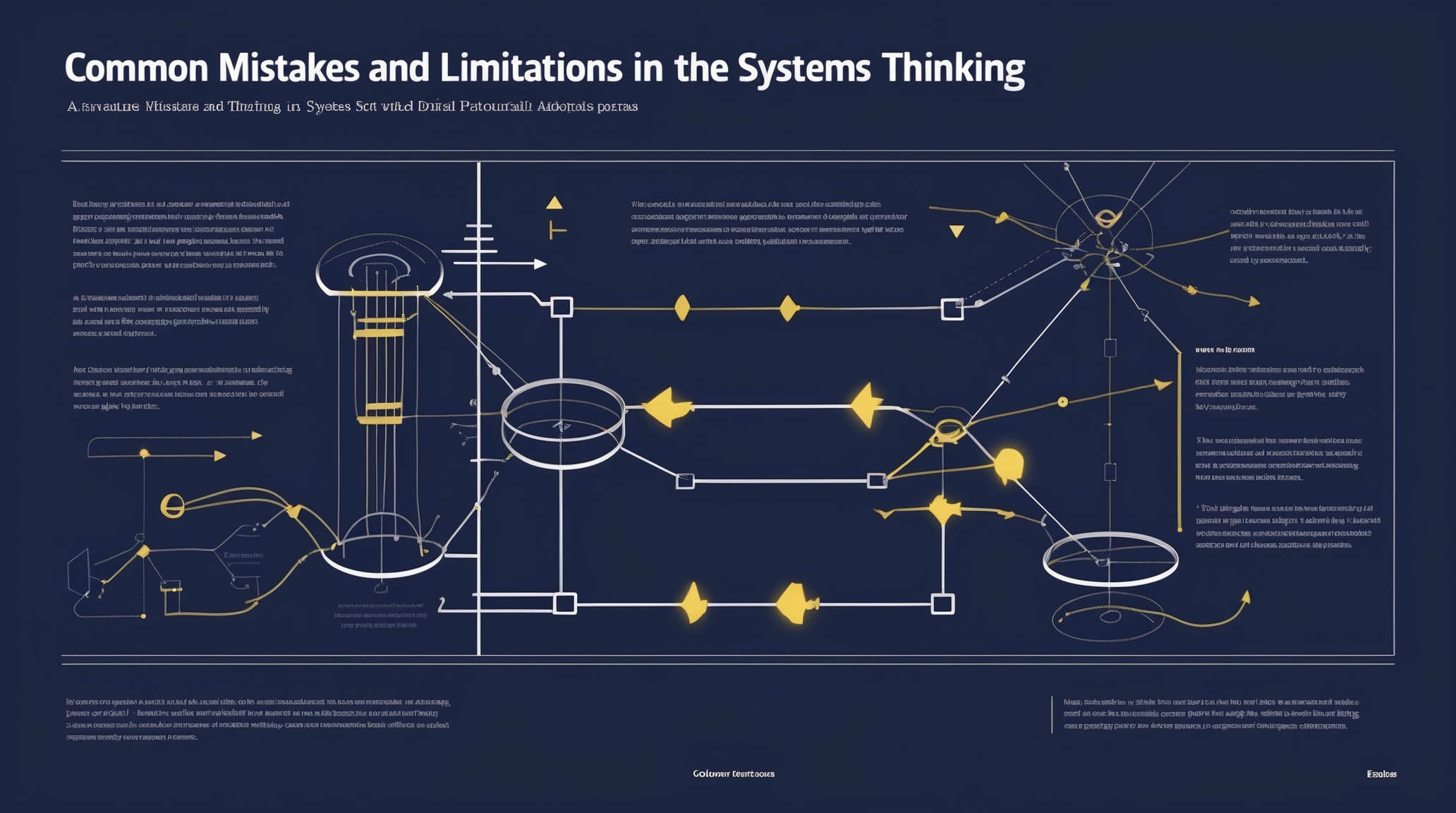
Systems thinking is powerful. It reveals structure, it exposes feedback loops, it explains why problems persist, and it identifies leverage points for change. But it is not magic, it is not universal, and it can be misused, misapplied, or taken too far. Like any tool, systems thinking has limitations, and like any framework, it can mislead if you do not understand when and how to use it appropriately.
Understanding the common mistakes people make when applying systems thinking, and understanding the limitations of the approach itself, is essential. Because systems thinking done badly is worse than no systems thinking at all. It creates the illusion of understanding while obscuring reality. It justifies inaction by claiming that everything is too complex to change. And it can become an intellectual exercise disconnected from the real struggles of people trying to solve real problems in real time.
Let me show you the common mistakes, the limitations, and when systems thinking is not the right tool.
The first common mistake is analysis paralysis. Systems thinking reveals complexity, it shows how everything is connected, how actions have unintended consequences, how feedback loops interact. And this can be overwhelming. You see so many factors, so many relationships, so many loops, that you do not know where to start. You do not know what to prioritize. And the complexity becomes an excuse for inaction, for saying that the system is too complicated, that we need more analysis, that we cannot intervene until we understand everything.
But you never understand everything. Systems are complex, they are always more complex than any model can capture, and waiting for complete understanding means never acting. Effective systems thinking requires balancing analysis with action, understanding enough to identify leverage points and then intervening, learning from the results, and adapting. The goal is not perfect understanding, it is useful understanding, enough to act more effectively than you would without systems thinking.
The second common mistake is ignoring agency and power. Systems thinking focuses on structure, on feedback loops, on patterns. And this can obscure the fact that systems are shaped by people, by decisions, by power. When you say that a problem is systemic, that it arises from structure, you risk making it seem inevitable, impersonal, as if no one is responsible, as if nothing can be done.
But systems are built by people, they are maintained by people, and they serve some people's interests at the expense of others. And changing systems requires confronting power, requires organizing against those who benefit from the current structure, and requires political action, not just technical analysis. Systems thinking that ignores power, that treats systems as neutral, as machines to be optimized, misses the most important dynamics and fails to create change.
The third common mistake is assuming that understanding equals solving. You map the system, you identify the feedback loops, you see why the problem persists, and you assume that this understanding will lead to solutions. But understanding is not solving. Knowing why a problem exists does not automatically tell you how to fix it, and knowing where leverage points are does not mean you can access them, especially if they are protected by power, by vested interests, or by political barriers.
Systems thinking provides insight, it clarifies structure, but it does not provide the will, the resources, or the political strategy needed to act on that insight. Those require organizing, coalition-building, negotiation, and sometimes conflict. And systems thinking, on its own, does not tell you how to do that.
The fourth common mistake is over-emphasizing feedback at the expense of linear causation. Systems thinking teaches that feedback loops are everywhere, that effects feed back into causes, and that systems are circular, not linear. And this is true, but it can lead to dismissing linear causation entirely, to assuming that everything is feedback, that there are no direct causes, only loops.
But sometimes causation is linear, at least in the short term or in specific contexts. If you cut funding for a program, the program shrinks. If you raise a tax, revenue increases. If you build a road, traffic increases. These are direct effects, and while they may eventually trigger feedback loops, understanding the immediate, linear impact is important. And ignoring linear causation, insisting that everything is complex and circular, can make systems thinking seem detached from practical reality.
The fifth common mistake is fetishizing complexity. Systems thinking reveals that systems are complex, and some people, excited by this insight, start to see complexity everywhere, to emphasize how complicated everything is, and to resist simplification. And while complexity is real, and simplification can be dangerous, over-emphasizing complexity can be paralyzing, elitist, and alienating.
People need actionable insights, they need to understand enough to make decisions, to act, to advocate. And if systems thinking produces only dense diagrams, jargon-heavy explanations, and warnings about unintended consequences, it does not serve them. Effective systems thinking simplifies without oversimplifying, it explains complexity clearly, and it translates insight into action.
The sixth common mistake is treating models as reality. Systems thinking uses models, diagrams, stock-and-flow charts, causal loop diagrams, archetypes. And models are useful, they clarify structure, they reveal patterns, they support analysis. But models are simplifications, they are representations, not reality. And mistaking the model for reality leads to errors.
A model includes some factors and excludes others, it emphasizes some relationships and ignores others, and it makes assumptions that may or may not hold. And if you trust the model too much, if you act as if the model is a complete description of reality, you miss what the model excludes, you overlook factors that matter, and your interventions fail.
Effective systems thinking uses models as tools, as aids to thinking, but remains skeptical, remains aware that the model is partial, and tests the model against reality, adjusting when the model fails to predict or explain.
The seventh common mistake is ignoring individual responsibility. Systems thinking emphasizes structure, and this can lead to absolving individuals of responsibility, to saying that people are just responding to incentives, that they are trapped by systems, and that blaming individuals is naive or counterproductive.
But individuals make choices, individuals have agency, and individuals can resist, can organize, can change systems. And some individuals have far more power than others, they design systems, they enforce rules, they benefit from extraction. And holding those individuals accountable, naming them, challenging them, is essential for change.
Systems thinking that ignores individual responsibility, that treats everyone as interchangeable components responding to incentives, misses the moral dimension, misses the question of justice, and risks excusing behavior that should be challenged.
Now let us talk about the limitations of systems thinking, the contexts where it is not the right tool or where other approaches are more useful.
The first limitation is that systems thinking is better at explaining the past than predicting the future. Systems thinking can show you why something happened, it can trace the feedback loops, the delays, the interactions that produced an outcome. But predicting what will happen is harder because systems are nonlinear, they have tipping points, they are sensitive to initial conditions, and small changes can have large, unpredictable effects.
So systems thinking is useful for diagnosis, for understanding structure, for identifying leverage points. But it is less useful for precise prediction, for forecasting exactly what will happen and when. And if you try to use systems thinking for prediction, you will often be wrong, and the failure will undermine confidence in the approach.
The second limitation is that systems thinking struggles with novelty. Systems thinking looks for patterns, for archetypes, for recurring structures. And this works well for systems that resemble past systems, that exhibit familiar dynamics. But when something truly new emerges, when the system is unlike anything seen before, systems thinking has less to offer. Because there are no analogies, no archetypes, no historical patterns to draw on.
In those cases, other approaches, experimentation, adaptive learning, scenario planning, may be more useful. And systems thinking can still help by clarifying what is known and what is uncertain, but it cannot provide the answers.
The third limitation is that systems thinking can underplay the importance of values and goals. Systems thinking focuses on structure, on how the system behaves given its goals, but it often takes the goals as given, as inputs, rather than interrogating them. And sometimes the problem is not the structure but the goals, not how the system achieves its purpose but what purpose it is trying to achieve.
And changing goals, changing what the system values, what it prioritizes, is a different kind of problem. It is not technical, it is political, moral, cultural. And systems thinking, which is fundamentally technical, does not tell you what goals to pursue, what values to hold, or what kind of world to build. Those are ethical and political questions, and they require ethical and political reasoning, not just systems analysis.
The fourth limitation is that systems thinking can be misused to justify inaction. Because systems are complex, because interventions have unintended consequences, because feedback loops make change difficult, systems thinking can be used to argue that we should not intervene, that we should let the system self-organize, that top-down action will backfire.
And while this is sometimes true, it can also be an excuse for protecting the status quo, for avoiding responsibility, for allowing harm to continue. Systems thinking should inform action, not prevent it. And when it is used to argue against intervention, you should ask who benefits from that argument, who is making it, and whether it is serving analysis or serving power.
Now let us talk about when to use other approaches instead of or alongside systems thinking.
Use reductionism when you need precision, when you need to understand how a specific component works, when isolating variables is appropriate. Systems thinking is holistic, but sometimes you need to zoom in, to focus narrowly, to understand one part deeply before understanding the whole.
Use narrative and storytelling when you need to communicate, to persuade, to engage people emotionally. Systems thinking is analytical, abstract, structural. But people connect with stories, with characters, with emotions. And if you want to move people to action, narrative is often more powerful than diagrams.
Use ethics and moral philosophy when you need to decide what should be, not just what is. Systems thinking explains how things work, but it does not tell you what is right, what is just, what goals to pursue. Those require ethical reasoning, and systems thinking, on its own, is neutral, amoral, and insufficient for moral questions.
Use political strategy when you need to build power, to organize, to challenge entrenched interests. Systems thinking can reveal who benefits and who loses, it can identify leverage points, but it does not organize protests, it does not build coalitions, it does not negotiate. Political change requires political action, and systems thinking is a tool for that action, not a replacement for it.
So here is what common mistakes and limitations reveal about systems thinking. Analysis without action is paralysis, and systems thinking should inform intervention, not prevent it. Ignoring power and agency makes systems thinking apolitical and ineffective. Understanding is not solving, and insight requires strategy, resources, and organization to create change. Feedback is important, but linear causation also matters, and dismissing it is a mistake. Complexity is real, but fetishizing it alienates and paralyzes. Models are tools, not reality, and should be used skeptically. Individual responsibility matters, even in systems. Systems thinking explains better than it predicts. It struggles with novelty. It can underplay values and goals. And it can be misused to justify inaction.
And the limitations mean that systems thinking should be combined with other approaches. Use reductionism for precision. Use narrative for communication. Use ethics for values. Use political strategy for power. Systems thinking is powerful, but it is not complete, and integrating it with other tools makes it more effective.
Systems thinking is a lens, a way of seeing, a framework for understanding. But it is not the only lens, not the only way of seeing, and not sufficient on its own. Use it where it helps, understand its limits, avoid common mistakes, and combine it with other approaches to see more clearly, to act more effectively, and to create the change you want to see.