Feedback Loops - The Deep Dive
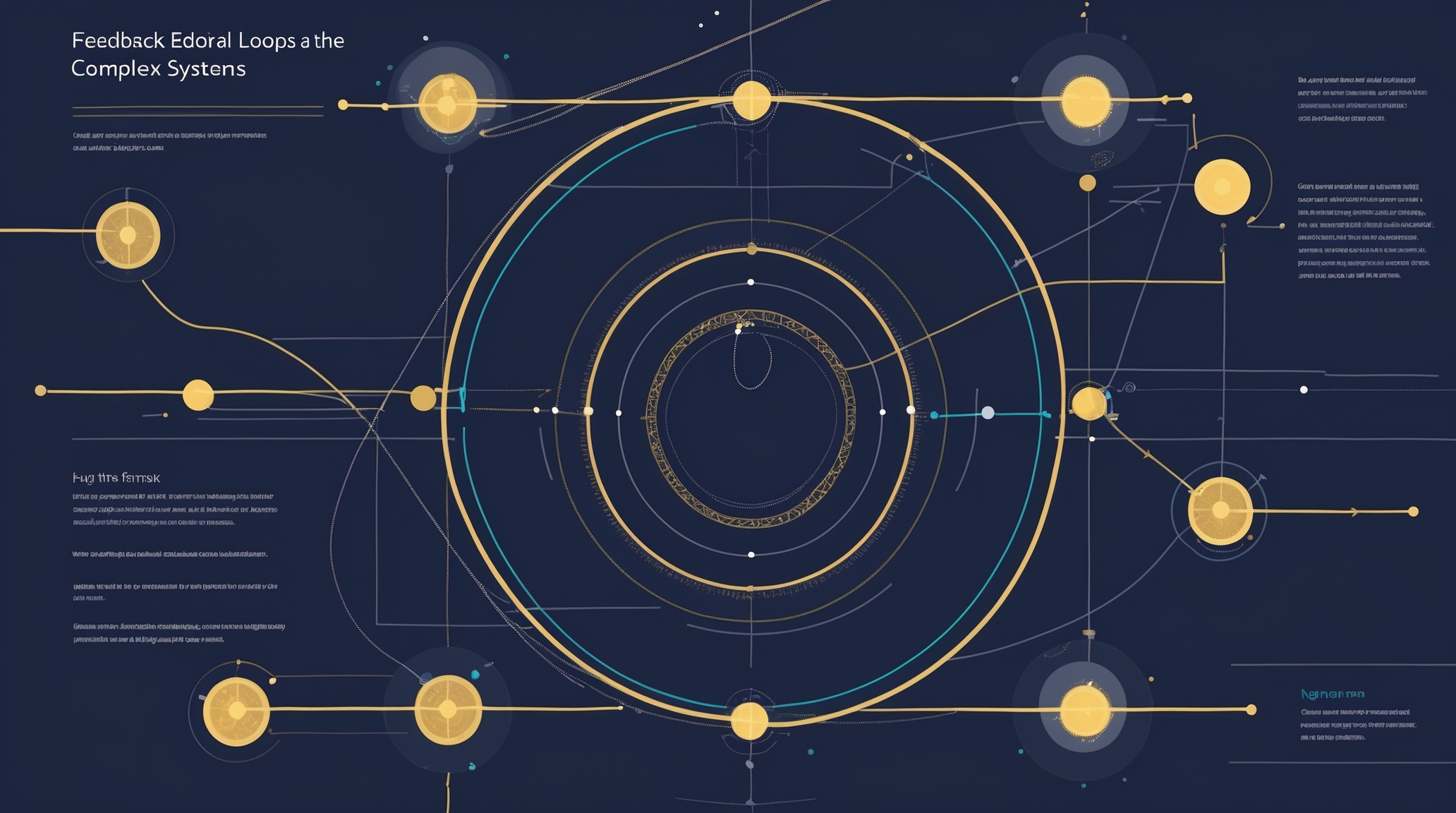
Feedback loops are the engine of system behavior. They are what make systems dynamic, what make them change over time, and what make them behave in ways that are often counterintuitive, surprising, and resistant to intervention. Understanding feedback loops is essential to understanding systems, because without feedback, systems would be static, predictable, and linear. But with feedback, systems become complex, they evolve, they spiral, they oscillate, and they often produce outcomes that no one intended and that are very difficult to reverse.
A feedback loop exists when a change in something eventually comes back to affect that same thing. A causes B, B causes C, and C causes A. The loop closes, the output feeds back into the input, and the cycle repeats. And this circularity, this self-reference, is what creates dynamics that linear thinking cannot capture.
There are two fundamental types of feedback loops: reinforcing loops and balancing loops. Reinforcing loops amplify change, they make things grow or shrink, they accelerate trends, and they create exponential behavior. Balancing loops resist change, they stabilize systems, they push toward equilibrium, and they create goal-seeking behavior. And every system contains both types of loops, often many of each, interacting in complex ways that determine the overall behavior.
Let me show you how feedback loops work, how they interact, and why they matter.
Start with reinforcing loops, also called positive feedback loops, though the term positive is misleading because reinforcing loops can create growth or collapse, boom or bust, virtuous circles or vicious spirals. What makes them reinforcing is that they amplify whatever is happening, if something is growing, a reinforcing loop makes it grow faster, and if something is shrinking, a reinforcing loop makes it shrink faster.
The simplest example is compound interest. You deposit money in a savings account that pays interest. The interest is added to your balance. And the next period, you earn interest not just on your original deposit but on your original deposit plus the previous interest. So your balance grows, which increases the interest, which increases the balance, which increases the interest further. This is a reinforcing loop. The more you have, the more you earn, and the more you earn, the more you have.
And this loop creates exponential growth. The balance does not grow linearly, by the same amount each period, it grows exponentially, by an increasing amount each period. At first, the growth is slow, barely noticeable, but over time, it accelerates, and what seemed like modest growth early on becomes dramatic growth later. This is the power of compounding, and it is why starting to save early makes such a huge difference, because the reinforcing loop has more time to operate.
But reinforcing loops also work in reverse. Debt with interest is a reinforcing loop in the opposite direction. You owe money, interest is charged, the debt grows, which increases the interest, which increases the debt further. If you are not repaying faster than interest accumulates, the debt spirals, it grows exponentially, and what seemed manageable becomes overwhelming. This is a vicious spiral, and it is driven by the same reinforcing loop structure as compound interest, just in the direction of collapse rather than growth.
Another example is wealth inequality. Wealth generates returns, through investment, through property appreciation, through access to opportunities. Those returns add to wealth, which generates more returns, which adds more wealth. This is a reinforcing loop. The wealthy get wealthier, not because they work harder or because they are smarter, but because wealth itself generates wealth. And this loop concentrates wealth, over time, in fewer and fewer hands, because those who start with more accumulate faster than those who start with less.
And the loop is self-perpetuating. Wealth buys access, to better education, to networks, to political influence, to opportunities that are not available to those without wealth. And that access generates more wealth, which buys more access, and the loop continues. This is why inequality, once it starts, is so hard to reverse, because it is driven by a reinforcing loop, and reinforcing loops accelerate.
Reinforcing loops also drive collapse. Consider a bank run. A bank holds deposits and makes loans, and it keeps only a fraction of deposits as reserves because most people do not withdraw all their money at once. But if people start to worry that the bank is in trouble, they withdraw their money. And withdrawals reduce the bank's reserves, which makes the bank look weaker, which increases worry, which causes more withdrawals. This is a reinforcing loop. The more people withdraw, the more fragile the bank becomes, and the more fragile it becomes, the more people withdraw.
And if the loop is not stopped, the bank fails. It runs out of reserves, it cannot meet withdrawals, and it collapses. And the collapse, caused by the reinforcing loop of panic and withdrawal, can happen very quickly, within days or even hours, because reinforcing loops accelerate. What starts as a trickle of withdrawals becomes a flood, and the bank, which was solvent yesterday, is insolvent today.
Now contrast this with balancing loops, also called negative feedback loops. Balancing loops resist change, they push systems toward a target, toward equilibrium, and they stabilize. If something is too high, a balancing loop brings it down. If something is too low, a balancing loop brings it up. And balancing loops are what make systems self-regulating, what allow them to maintain stability despite disturbances.
The simplest example is a thermostat. You set a target temperature, say twenty degrees. If the room is colder than twenty degrees, the thermostat turns on the heating. The heating warms the room. When the room reaches twenty degrees, the thermostat turns off the heating. If the room gets warmer than twenty degrees, the thermostat might turn on cooling, or it just stops heating and lets the room cool naturally. This is a balancing loop. The system senses the gap between the current state and the target state, and it acts to close that gap.
And balancing loops create stability. The room temperature does not spiral out of control, it does not get hotter and hotter or colder and colder, it stabilizes around the target. And this stability exists because the loop is balancing, it counteracts change, it pushes back.
Another example is supply and demand in markets, at least in theory. If prices are high, demand falls and supply increases, which brings prices down. If prices are low, demand rises and supply falls, which brings prices up. This is a balancing loop. Prices oscillate around an equilibrium where supply equals demand, and deviations from equilibrium trigger forces that push prices back.
But here is the complication, balancing loops do not always work smoothly. They can create oscillations, overshooting and undershooting the target, because of delays. If there is a delay between sensing the gap and acting, or between acting and seeing the result, the system can overreact, overshoot, and then have to correct in the opposite direction.
Consider a shower. You turn on the water, it is cold, so you turn up the hot tap. But there is a delay, the hot water has to travel through the pipes. So you wait. Still cold. You turn the hot tap up more. Still cold. You turn it up even more. And then, suddenly, scalding hot water arrives, all at once, because you turned the tap up so much. You jump back, turn the hot tap down, turn up the cold. But now there is a delay before the cold water arrives, and you are still being scalded. You turn the hot down even more, turn the cold up even more. And then, suddenly, freezing water arrives. And you repeat the cycle, oscillating between too hot and too cold, never quite settling on the right temperature.
This is a balancing loop with delay. The delay between action and result causes you to overreact, to overshoot, and the system oscillates. And the same thing happens in markets, in supply chains, in policy. Governments see unemployment rising, so they stimulate the economy. But there is a delay before the stimulus takes effect, so they stimulate more. And then, months later, the economy overheats, inflation rises, and they have to tighten policy. But there is a delay before tightening takes effect, so they tighten more. And the economy oscillates between boom and bust, driven by a balancing loop with delay.
Now here is where it gets really interesting, when reinforcing and balancing loops interact. Most systems contain both types, and the behavior of the system depends on which loop dominates at any given time.
Consider population growth. There is a reinforcing loop, more people means more births, which means more people. This drives exponential growth. But there is also a balancing loop, more people means more competition for resources, which increases death rates or reduces birth rates, which slows growth. At low populations, the reinforcing loop dominates, and the population grows exponentially. But as the population approaches the carrying capacity of the environment, the balancing loop strengthens, and growth slows. Eventually, the loops balance, and the population stabilizes.
But this assumes the balancing loop is strong enough. If it is not, if the population grows too fast and overshoots the carrying capacity, the balancing loop might kick in too late, and the population crashes. This is overshoot and collapse, and it is driven by the interaction of reinforcing and balancing loops with delay.
Or consider technology adoption. Early on, a reinforcing loop dominates. A few people adopt a new technology, they talk about it, others adopt it, which makes it more valuable because of network effects, which causes more adoption. This is exponential growth. But eventually, a balancing loop kicks in, the market saturates, everyone who wants the technology has it, and growth slows. The system transitions from reinforcing-loop-dominated growth to balancing-loop-dominated stability.
But if the technology is disruptive, if it undermines itself or creates backlash, a different balancing loop might dominate. Social media grew exponentially through network effects, a reinforcing loop. But as it grew, it created problems, misinformation, addiction, polarization, and these problems triggered backlash, regulation, user exodus. This is a balancing loop, the more the platform grows, the more problems it creates, and the more problems it creates, the more it undermines its own growth.
Now let us talk about loop dominance, which loop is in control. In the early stages of a system, reinforcing loops often dominate, which is why systems often exhibit rapid growth or rapid decline at the start. But as the system matures, balancing loops strengthen, and the system stabilizes. Understanding which loop dominates at which stage is essential for predicting behavior and for knowing when and how to intervene.
And let us talk about nested loops, loops within loops. In complex systems, there are multiple loops operating at different scales and different speeds. A fast reinforcing loop might drive short-term growth, but a slow balancing loop might limit long-term growth. And the interaction between fast and slow loops creates complex behavior that is difficult to predict.
Consider climate. There is a fast reinforcing loop, warming melts ice, which reduces reflectivity, which increases warming, which melts more ice. This loop accelerates warming in the short term. But there is a slow balancing loop, warming increases ocean absorption of CO2, which eventually reduces atmospheric CO2, which slows warming. The fast loop dominates in the short term, creating rapid change, but the slow loop might stabilize the system in the long term, though on a timescale of centuries.
And nested loops create path dependency. The fast loop might push the system past a tipping point before the slow loop can stabilize it, and once past that tipping point, the system might lock into a new state. This is why timing matters, intervening early, when the fast reinforcing loop is still weak, is easier than intervening late, when the loop has accelerated and the system is locked into a trajectory.
So here is what feedback loops reveal about systems. Reinforcing loops create growth or collapse, they accelerate trends, and they drive exponential behavior. Balancing loops create stability, they resist change, and they push toward equilibrium. Delays cause oscillation, overshooting and undershooting, and make systems harder to control. Loop dominance determines whether a system grows, shrinks, or stabilizes, and understanding which loop is in control is essential for prediction. And nested loops create complex dynamics where fast loops drive short-term behavior and slow loops shape long-term outcomes.
And feedback loops explain why systems resist intervention. If you intervene without understanding the loops, you might strengthen the wrong loop or trigger an unintended loop. You might push against a reinforcing loop, which accelerates in response, or you might disrupt a balancing loop, which destabilizes the system. And you might ignore delays, which means your intervention either arrives too late or overshoots.
Effective intervention requires identifying the loops, understanding which ones are reinforcing and which are balancing, understanding which dominate and when, and understanding where delays exist. And then intervening not by pushing harder, not by treating symptoms, but by changing the loop structure, by weakening reinforcing loops that are driving undesirable growth or collapse, or by strengthening balancing loops that stabilize the system, or by reducing delays that cause oscillation.
Feedback loops are everywhere. In economics, in ecology, in psychology, in organizations, in relationships. And once you see them, once you understand how they work, you see why systems behave the way they do. Why wealth concentrates. Why bank runs happen. Why markets oscillate. Why populations overshoot. Why policies backfire. All of it is feedback loops, interacting, competing, amplifying, balancing, and creating the complex, dynamic, often frustrating behavior that makes systems so difficult to manage.
The next article will show you nonlinearity and tipping points, the moments when small causes produce large effects, when gradual change suddenly becomes rapid change, and when systems cross thresholds that lock them into new states that are very difficult to reverse.