Nonlinearity and Tipping Points
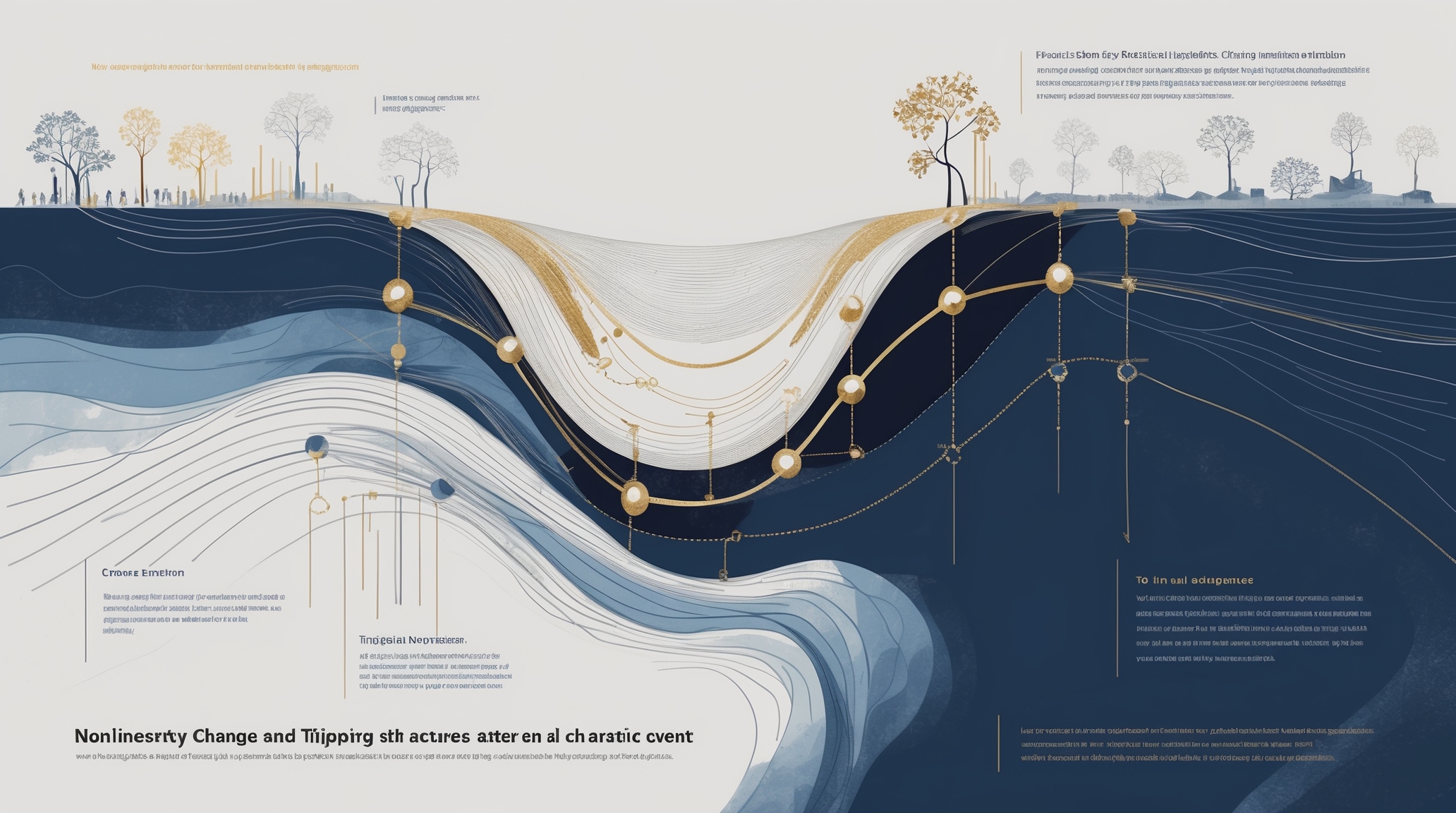
We like to think the world works in straight lines. That causes are proportional to effects, that small actions produce small results and large actions produce large results, and that if you push twice as hard, you get twice the result. This is linear thinking, and it makes the world feel predictable, controllable, and fair. If you work twice as hard, you earn twice as much. If you study twice as long, you learn twice as much. If you invest twice as much, you get twice the return.
But the world does not work this way. The world is nonlinear. Small actions can produce enormous results, and large actions can produce almost nothing. Gradual change can suddenly become explosive change. Systems can absorb pressure for years and then collapse in days. And thresholds exist where crossing a line, even by a tiny amount, fundamentally changes the system in ways that are very difficult or impossible to reverse.
This is nonlinearity, and it is one of the most important and least understood aspects of systems. It explains why predictions fail, why interventions backfire, why crises seem to come from nowhere, and why systems that appear stable can suddenly break. And understanding nonlinearity, understanding tipping points, is essential for anyone who wants to navigate complex systems, because linear intuition will mislead you, will make you complacent when you should be alarmed, and will make you act too weakly or too late.
Let me show you how nonlinearity works and why tipping points matter.
Start with a simple example, pushing a box across the floor. At first, you push and nothing happens. The box does not move. You push harder, still nothing. You push harder still, and suddenly the box slides across the floor. This is nonlinear behavior. The force you apply increases gradually, steadily, but the result, the movement, is zero for a while and then suddenly large. There is a threshold, the point where static friction is overcome, and below that threshold, no amount of pushing moves the box, and above that threshold, even a tiny additional push causes movement.
This is a simple physical example, but the principle applies everywhere. Systems resist change until a threshold is crossed, and then they change rapidly. And this creates the illusion that the change was sudden, that it came from nowhere, when in reality the pressure was building gradually, invisibly, and the crossing of the threshold was the moment when accumulated pressure was released.
Now consider an epidemic. A disease spreads through a population, and early on, the number of cases grows slowly. A few people are infected, they infect a few more, and the numbers tick up gradually. But then something changes. The number of cases starts doubling every few days, then every day, and suddenly the epidemic is everywhere, overwhelming hospitals, dominating the news, and governments are declaring emergencies. This is exponential growth, driven by a reinforcing feedback loop, and it is nonlinear because the rate of increase accelerates as the number of cases grows.
But there is also a threshold, a tipping point, where the epidemic transitions from containable to uncontrollable. Early on, when cases are few, contact tracing works, isolation works, and the disease can be suppressed. But once cases exceed the capacity of the public health system to track and isolate them, the disease spreads unchecked, and containment becomes impossible. The system crosses a threshold, and the dynamics change fundamentally.
And this threshold is not obvious. You do not know you have crossed it until you are well past it, because the effects lag, because the exponential growth is still accelerating, and because the system looks manageable right up until it is not. This is why early action matters so much in epidemics, because acting before the threshold prevents crossing it, and acting after the threshold requires far more drastic and far more costly measures.
Now consider climate change. The Earth's climate has feedback loops, some balancing, some reinforcing, and for most of human history, the balancing loops dominated, which kept the climate relatively stable. But as CO2 emissions have increased, the system has been pushed, and reinforcing loops are strengthening. Warming melts ice, which reduces reflectivity, which increases warming. Warming thaws permafrost, which releases methane, which increases warming. Warming reduces forest cover, which reduces CO2 absorption, which increases warming.
These are reinforcing loops, and they create the potential for tipping points, thresholds where the system transitions from a balanced state to a reinforcing state, from stability to runaway change. If warming crosses certain thresholds, ice sheets might collapse, releasing enough water to raise sea levels by meters. Permafrost might thaw irreversibly, releasing enough methane to accelerate warming by decades. Ocean currents might shift, changing weather patterns globally.
And the critical feature of tipping points is that they are often irreversible, or very difficult to reverse. Once an ice sheet collapses, it does not simply re-form if temperatures drop. Once permafrost thaws, it does not simply re-freeze. The system locks into a new state, and returning to the old state requires not just reversing the change but overcoming the new dynamics, the new feedback loops, that have been triggered.
This is why climate scientists talk about two degrees of warming, or one and a half degrees, as critical thresholds. Not because one point nine degrees is safe and two point one degrees is catastrophic, but because somewhere in that range, the risk of crossing tipping points increases dramatically, and once crossed, the system enters a regime where human control is lost and natural reinforcing loops dominate.
Now consider financial markets. Markets are nonlinear because they are driven by feedback loops, by sentiment, by momentum, by herding behavior. When markets are rising, optimism spreads, more people buy, which pushes prices higher, which attracts more buyers. This is a reinforcing loop, and it creates bubbles, periods where prices rise far beyond any rational valuation, driven purely by the expectation that they will keep rising.
But bubbles are unstable because they depend on confidence, and confidence can evaporate quickly. At some point, a trigger, bad news, a missed earnings report, a change in policy, causes some investors to sell. Prices fall slightly. Other investors, seeing prices fall, sell too. Prices fall more. Panic spreads. Everyone tries to sell at once. And the market crashes. This is nonlinear behavior, from bubble to crash, triggered by crossing a threshold of confidence.
And the crash is always faster than the rise. Bubbles inflate gradually, over months or years, because buying is incremental, optimistic, and sustained. But crashes happen in days or hours, because selling is panicked, urgent, and self-reinforcing. The asymmetry, slow rise and fast crash, is a signature of nonlinearity, and it is why crashes always surprise people, even though they are inevitable, because people experience the gradual rise and extrapolate, assuming the gradual trend will continue, and they are unprepared for the sudden collapse.
Now consider social movements. Change happens slowly for years, pressure builds, grievances accumulate, but the system appears stable, nothing seems to change. And then, suddenly, a spark, a protest, an incident, and the system explodes. Millions take to the streets, regimes fall, laws change, and the world looks different. This is a tipping point, where accumulated pressure crosses a threshold, and latent discontent becomes active mobilization.
And the spark, the trigger, is often trivial, a single event that would have been ignored in another context. But in a system at the edge of a tipping point, small events have large effects because the system is primed, it is under tension, and it needs only a small push to release that tension. This is why revolutions seem to come from nowhere, why they are unpredictable, because the pressure is invisible until it is released, and the release is triggered by events that seem, in isolation, insignificant.
Now let us talk about thresholds and phase transitions. A threshold is a boundary, a point where the rules change, where the system transitions from one regime to another. And phase transitions are familiar from physics, water freezes at zero degrees, it boils at one hundred degrees, and at those thresholds, the properties of water change fundamentally. Ice is solid, water is liquid, steam is gas, and the transitions between these states are sharp, nonlinear, and driven by crossing temperature thresholds.
But phase transitions happen in all kinds of systems, not just physical ones. Societies transition from peace to war, from stability to chaos, from trust to distrust. Organizations transition from functional to dysfunctional, from growing to declining, from innovative to stagnant. And these transitions often happen at thresholds, where accumulated stress, accumulated change, or accumulated pressure crosses a critical point and the system shifts.
And phase transitions are often irreversible, or very difficult to reverse. Once trust is lost, rebuilding it is far harder than maintaining it. Once an organization becomes dysfunctional, fixing it requires more than just reversing the changes that broke it, it requires overcoming the inertia, the habits, the culture that have developed. Once a society descends into conflict, achieving peace requires more than just removing the original grievance, it requires healing trauma, rebuilding institutions, and restoring social cohesion.
Now let us talk about why nonlinearity makes prediction so difficult. In linear systems, you can extrapolate, you can assume that trends continue, that relationships are stable, and that small changes produce small effects. But in nonlinear systems, extrapolation fails. Trends do not continue, they accelerate or reverse. Relationships are not stable, they shift at thresholds. And small changes can produce large effects if they cross a threshold or trigger a reinforcing loop.
This is why experts, despite access to data, despite sophisticated models, fail to predict crises. They are modeling linear relationships, assuming proportionality, assuming stability. But the system is nonlinear, and it behaves in ways that violate those assumptions. And when the system crosses a threshold, when a tipping point is reached, the models break, the predictions fail, and the experts are surprised.
And this is also why early warning signs are often ignored. Before a crisis, before a threshold is crossed, the system looks stable, the trends look manageable, and warnings are dismissed as alarmist. But the system is at the edge, it is under stress, and small additional pressure can tip it. And by the time the crisis is obvious, by the time the threshold has been crossed, it is too late to prevent it, and the only option is crisis management, which is far more costly and far less effective than prevention.
So here is what nonlinearity and tipping points reveal about systems. Small causes can produce large effects if they trigger feedback loops or cross thresholds. Gradual pressure can accumulate invisibly until a threshold is crossed and change becomes rapid and dramatic. Thresholds often mark irreversible transitions where the system locks into a new state. Phase transitions, from one regime to another, happen at critical points and are often difficult or impossible to reverse. And prediction fails in nonlinear systems because extrapolation assumes proportionality and stability that do not exist.
And this has profound implications for intervention. In linear systems, you can intervene proportionally, a small problem requires a small fix, a large problem requires a large fix. But in nonlinear systems, timing matters more than scale. A small intervention before a threshold can prevent a crisis. A large intervention after a threshold might fail to reverse it. And knowing where the thresholds are, understanding when the system is approaching a tipping point, is far more valuable than knowing the current state.
But identifying thresholds is difficult because they are not always obvious, they do not announce themselves, and they are often only visible in hindsight. But there are warning signs: increasing volatility, slowing recovery from disturbances, increasing correlation between parts of the system, and increasing sensitivity to small shocks. These are signals that the system is losing resilience, that it is approaching a threshold, and that intervention is urgent.
Nonlinearity is everywhere. In markets, in climate, in ecosystems, in societies, in organizations. And once you understand it, once you stop assuming proportionality and start looking for thresholds, you see why systems behave the way they do. Why crises seem sudden. Why interventions fail. Why small changes sometimes matter enormously and large changes sometimes matter not at all. And why, in complex systems, the most important question is not how much pressure the system is under, but whether it is approaching a threshold, because crossing that threshold changes everything.
The next article will show you emergence and self-organization, how order arises from chaos, how complex behavior emerges from simple rules, and why systems often produce outcomes that no one designed, no one intended, and no one can control.