Resilience vs Efficiency
You manage a system, an organization, a supply chain, a hospital, a city, and you face pressure to be efficient. To do more with less. To cut costs, to eliminate waste, to optimize processes, to maximize output per unit of input. And efficiency sounds good, it sounds like smart management, like fiscal responsibility, like getting value for money. And in stable, predictable conditions, efficiency delivers results. Lower costs, higher output, better margins, faster operations.
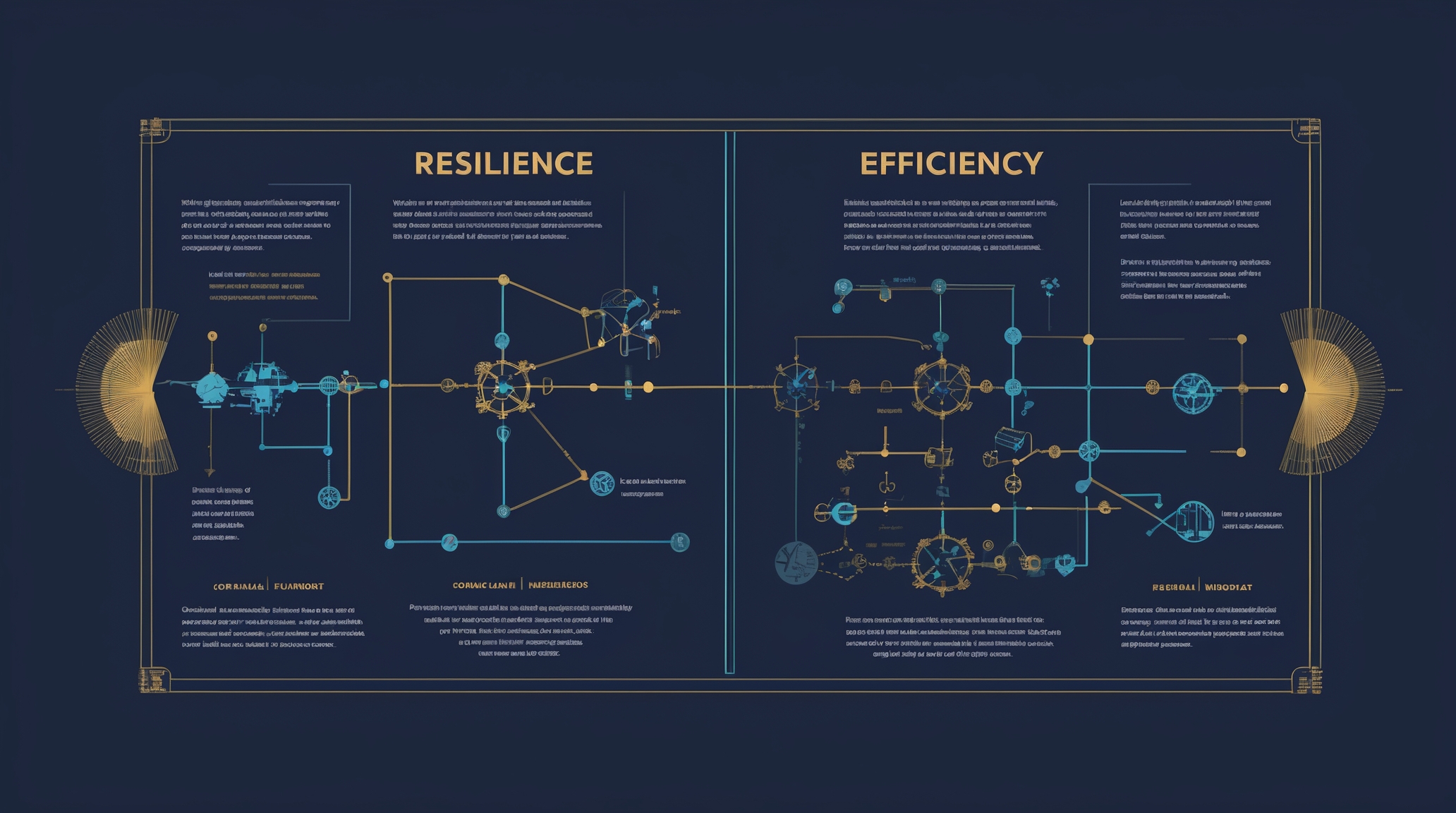
But efficiency comes at a cost, a cost that is not visible in normal conditions but becomes catastrophic when conditions change, when shocks occur, when the unexpected happens. That cost is resilience. Resilience is the capacity of a system to absorb disturbances, to adapt to change, to recover from shocks without collapsing. And resilience requires redundancy, requires slack, requires spare capacity, requires diversity, all the things that efficiency drives out.
This is the resilience-efficiency trade-off, and it is one of the most important and most misunderstood dynamics in systems. Organizations, governments, and individuals optimize for efficiency because the benefits are immediate and measurable. But they sacrifice resilience, and the cost of that sacrifice is invisible until a shock occurs. And when the shock occurs, when the pandemic hits, when the supply chain breaks, when the financial crisis strikes, the optimized system collapses. And people, looking at the wreckage, wonder how this could have happened. Why the system was so fragile. Why there was no capacity to respond.
Let me show you how the resilience-efficiency trade-off works and why it matters.
Start with a simple example, inventory. A business holds inventory, raw materials, components, finished goods, to buffer against variability in supply and demand. If a supplier is late, inventory covers the gap. If demand spikes, inventory meets it. This is resilience, the capacity to absorb shocks, to maintain operations despite disruptions.
But inventory costs money. It ties up capital, it requires storage space, it risks obsolescence, and it does not generate revenue sitting on a shelf. So efficiency-minded management reduces inventory, adopts just-in-time manufacturing, where components arrive exactly when needed, with minimal buffer. This reduces costs, frees up capital, improves cash flow, and in stable conditions, it works beautifully. Operations are lean, efficient, profitable.
But just-in-time is fragile. If a supplier is late, if a shipment is delayed, if demand spikes unexpectedly, there is no buffer. Production stops, orders are missed, customers are lost. And the system, optimized for efficiency, has no resilience. It cannot absorb even small shocks. And when a large shock occurs, a pandemic that disrupts global supply chains, a natural disaster that closes factories, a geopolitical crisis that blocks trade routes, the system collapses entirely.
This is what happened during COVID. Supply chains optimized for efficiency, with minimal inventory and no redundancy, could not adapt when factories closed, when shipping was disrupted, when demand patterns shifted. And businesses that had eliminated buffers in pursuit of efficiency found themselves unable to produce, unable to deliver, and unable to respond. And rebuilding resilience, adding inventory, diversifying suppliers, creating redundancy, was expensive and slow.
Now consider healthcare. A hospital operates efficiently by minimizing excess capacity. It aims for high bed occupancy, high utilization of staff and equipment, minimal idle time. This reduces costs, maximizes revenue per bed, and in normal conditions, it works. Patients are treated, surgeries are performed, the hospital is productive and financially stable.
But hospitals with high occupancy have no surge capacity. If demand spikes, if a flu season is severe, if an accident creates mass casualties, if a pandemic hits, the hospital is immediately overwhelmed. There are no spare beds, no spare staff, no spare ventilators. And the hospital, optimized for efficiency, cannot respond. Patients are turned away, care is rationed, outcomes worsen, and the system breaks.
This is what happened during COVID. Hospitals in many countries were operating at high efficiency, at high occupancy, with minimal slack. And when the pandemic hit, they had no capacity to surge, no ability to scale up, and they were overwhelmed within days. And the cost of that lack of resilience was measured in lives, in delayed treatments, in exhausted staff, in systemic failure.
Now consider staffing. An organization operates efficiently by minimizing staff. It hires exactly enough people to perform the required work, with minimal redundancy. If someone is sick, if someone leaves, if demand increases, the organization stretches, it asks remaining staff to work harder, to work longer, to cover the gap. And in the short term, this works. Costs are low, productivity per employee is high, the organization is lean.
But lean staffing is brittle. If multiple people are sick, if turnover is high, if a project requires unexpected effort, there is no capacity to absorb it. Remaining staff burn out, quality declines, deadlines are missed, and the organization struggles. And chronic understaffing erodes morale, drives turnover, and creates a vicious cycle where the organization is perpetually firefighting, unable to plan, unable to invest, unable to improve.
And rebuilding staffing capacity, hiring and training new people, is slow and expensive. And during the rebuilding period, the organization continues to struggle, continues to underperform, and continues to lose people who are exhausted and demoralized.
Now consider financial reserves. An individual, a business, or a government operates efficiently by minimizing cash reserves. Idle cash does not generate returns, so efficiency-minded management invests it, spends it, puts it to work. And in stable conditions, this maximizes returns, maximizes growth, and looks like smart financial management.
But reserves are resilience. They provide a buffer against shocks, against unexpected expenses, against loss of income. And without reserves, a small shock, a medical bill, a broken appliance, a lost job, a revenue shortfall, becomes a crisis. The individual, the business, the government has no capacity to absorb the shock, so they borrow, they cut essentials, they make decisions that worsen their situation. And the lack of reserves turns a manageable problem into a catastrophic one.
This is why financial advisors recommend emergency funds, three to six months of expenses held in liquid, accessible form. Not because those funds generate returns, they do not, but because they provide resilience, they allow you to absorb shocks without spiraling into debt or making desperate decisions.
Now consider diversity. A system operates efficiently by standardizing, by reducing diversity, by optimizing around a single best practice. One supplier, one process, one technology, one approach. This reduces complexity, reduces coordination costs, and increases efficiency. Everyone does things the same way, and that way is optimized.
But standardization is fragile. If the single supplier fails, if the single process breaks, if the single technology becomes obsolete, the entire system is vulnerable. There is no alternative, no fallback, no diversity to absorb the shock. And the system, optimized for efficiency through standardization, collapses when the standard fails.
This is why monocultures in agriculture are vulnerable. A field planted with a single crop variety is efficient, planting is uniform, harvesting is uniform, yields are high. But if a pest or disease affects that variety, the entire crop fails. Diversity, multiple varieties, provides resilience. Some varieties may be affected, but others survive, and the system as a whole endures.
And this applies to organizations, to economies, to technologies. Diversity provides options, provides adaptability, provides resilience. But diversity is inefficient in stable conditions, it creates complexity, it reduces uniformity, it lowers average performance. So efficiency-minded management reduces diversity, and the system becomes brittle.
Now let us talk about the illusion of efficiency. Efficiency is measured in stable conditions, in normal times. Cost per unit, output per worker, return on investment, occupancy rate. These metrics look good when conditions are predictable, when shocks are rare, when the system is not stressed. But they ignore resilience, they ignore the capacity to handle the unexpected, and they create the illusion that the system is performing well when in fact it is fragile.
And when a shock occurs, the optimized system fails catastrophically, and the failure costs far more than the efficiency gains saved. A hospital that saves money by operating at high occupancy incurs enormous costs when it is overwhelmed, costs in lives, in staff burnout, in reputation, in deferred treatments. A supply chain that saves money by eliminating inventory incurs enormous costs when it breaks, costs in lost sales, in damaged relationships, in scrambling for alternatives.
So efficiency, measured in stable conditions, can be a trap. It looks good, it generates savings, it is rewarded by metrics and by management incentives. But it creates vulnerability that is invisible until it is too late.
Now let us talk about why efficiency is prioritized over resilience. The first reason is that the benefits of efficiency are immediate and measurable, while the benefits of resilience are delayed and uncertain. Cutting costs today improves this quarter's financial results, it generates immediate savings, it is visible and rewarded. But building resilience costs money today, and the benefit, avoiding a future shock, is uncertain, it may never occur, and if it does, it is hard to attribute to the resilience investment.
So managers, operating on short time horizons, prioritize efficiency. They are judged on quarterly results, on annual performance, not on long-term resilience. And shareholders, investors, and voters reward short-term gains and punish short-term costs, even when those costs build resilience that will pay off later.
The second reason is that resilience looks like waste. Spare capacity, idle resources, redundancy, all look inefficient. An empty hospital bed looks like a wasted resource. Inventory sitting on a shelf looks like tied-up capital. Extra staff look like overstaffing. And in stable conditions, they are waste, they do not contribute to output, they do not generate revenue, they do not improve metrics.
So efficiency-minded management eliminates them, and performance improves, measured by the metrics that matter in stable conditions. But the capacity to absorb shocks, the resilience, is lost, and the system becomes fragile.
The third reason is that resilience is hard to demonstrate. You cannot prove that a shock would have occurred and that resilience prevented it. You can only show that the system absorbed a shock when it occurred, but by then, the investment in resilience has already been made, and the counterfactual, what would have happened without resilience, is invisible.
So advocates for resilience struggle to make the case, they cannot point to immediate benefits, they can only warn of future risks, and warnings are easy to dismiss as alarmist, as overly cautious, as wasteful.
Now let us talk about how to balance efficiency and resilience. The key is recognizing that the optimal balance depends on the stability of the environment. In highly stable, predictable environments, efficiency is appropriate because shocks are rare and manageable. But in volatile, uncertain environments, resilience is essential because shocks are frequent and potentially catastrophic.
And most systems operate in environments that are more volatile than they acknowledge. Organizations assume stability, they plan based on past patterns, and they are surprised by shocks that disrupt those patterns. But shocks, disruptions, crises, are not rare anomalies, they are features of complex systems, and they occur regularly. Pandemics, financial crises, natural disasters, technological disruptions, geopolitical shocks. All of these are predictable in the sense that we know they will occur, even if we do not know when or where.
So building resilience is not preparing for unlikely worst-case scenarios, it is preparing for events that are certain to occur eventually. And the cost of resilience, the redundancy, the slack, the diversity, is insurance, it is the price of surviving shocks that will inevitably come.
And the balance between efficiency and resilience should reflect values and priorities. If the priority is maximizing short-term performance, efficiency dominates. But if the priority is long-term survival, adaptability, and the capacity to serve through crises, resilience must be prioritized, even at the cost of short-term efficiency.
So here is what the resilience-efficiency trade-off reveals about systems. Efficiency optimizes performance in stable conditions but creates fragility. Resilience provides the capacity to absorb shocks but requires redundancy, slack, and diversity that look like waste. The benefits of efficiency are immediate and measurable, while the benefits of resilience are delayed and uncertain, which creates bias toward efficiency. Systems optimized for efficiency fail catastrophically when stressed because they have no capacity to absorb shocks. And balancing efficiency and resilience requires recognizing that shocks are inevitable, that survival matters more than optimization, and that resilience is not waste but insurance.
The resilience-efficiency trade-off is everywhere. In supply chains, in healthcare, in staffing, in finance, in infrastructure, in ecosystems. And once you see it, once you understand the trade-off, you see why systems that look efficient often collapse, why organizations that prioritize leanness fail under pressure, and why preparing for shocks, building buffers, maintaining spare capacity, is not wasteful but essential.
The final article in this series will show you common mistakes and limitations of systems thinking, the ways it can be misused, the ways it can mislead, and when other approaches are more appropriate. Because systems thinking is powerful, but it is not universal, and understanding its limits is as important as understanding its strengths.