Stocks, Flows, and Accumulation
f you want to understand any system, you need to understand two things: stocks and flows. These are the fundamental building blocks, the basic structure that underlies every system you will ever analyze. And once you see them, once you understand how they work and how they relate to each other, you will see them everywhere. In your bank account, in your bathtub, in populations, in knowledge, in infrastructure, in debt, in trust, in everything.
A stock is an accumulation. It is a quantity that exists at a point in time. Water in a bathtub. Money in a bank account. People in a population. Carbon in the atmosphere. Debt on a balance sheet. Knowledge in your head. Infrastructure in a city. A stock is what you measure when you take a snapshot, when you ask how much is there right now.
A flow is a rate of change. It is the amount added to or subtracted from a stock over time. Water flowing into the bathtub from the tap. Money flowing into your account from your salary. Births adding to a population. Emissions adding carbon to the atmosphere. Borrowing adding to debt. Learning adding to knowledge. Investment adding to infrastructure. A flow is what you measure when you ask how fast is it changing.
And the relationship between stocks and flows is simple but profound: stocks change through flows, and only through flows. If you want to increase a stock, you increase the inflow or decrease the outflow. If you want to decrease a stock, you decrease the inflow or increase the outflow. There is no other way. Stocks do not change by themselves, they change because flows change them.
This sounds obvious, trivially simple, but it is not. Because most people, most of the time, focus on stocks and ignore flows. They see the bathtub is full and assume it will stay full. They see the bank account is healthy and assume it will stay healthy. They see the population is growing and assume it will keep growing. And they are surprised, confused, angry when stocks change in ways they did not expect. Because they were not watching the flows.
Let me show you why stocks and flows matter and how understanding them changes the way you see systems.
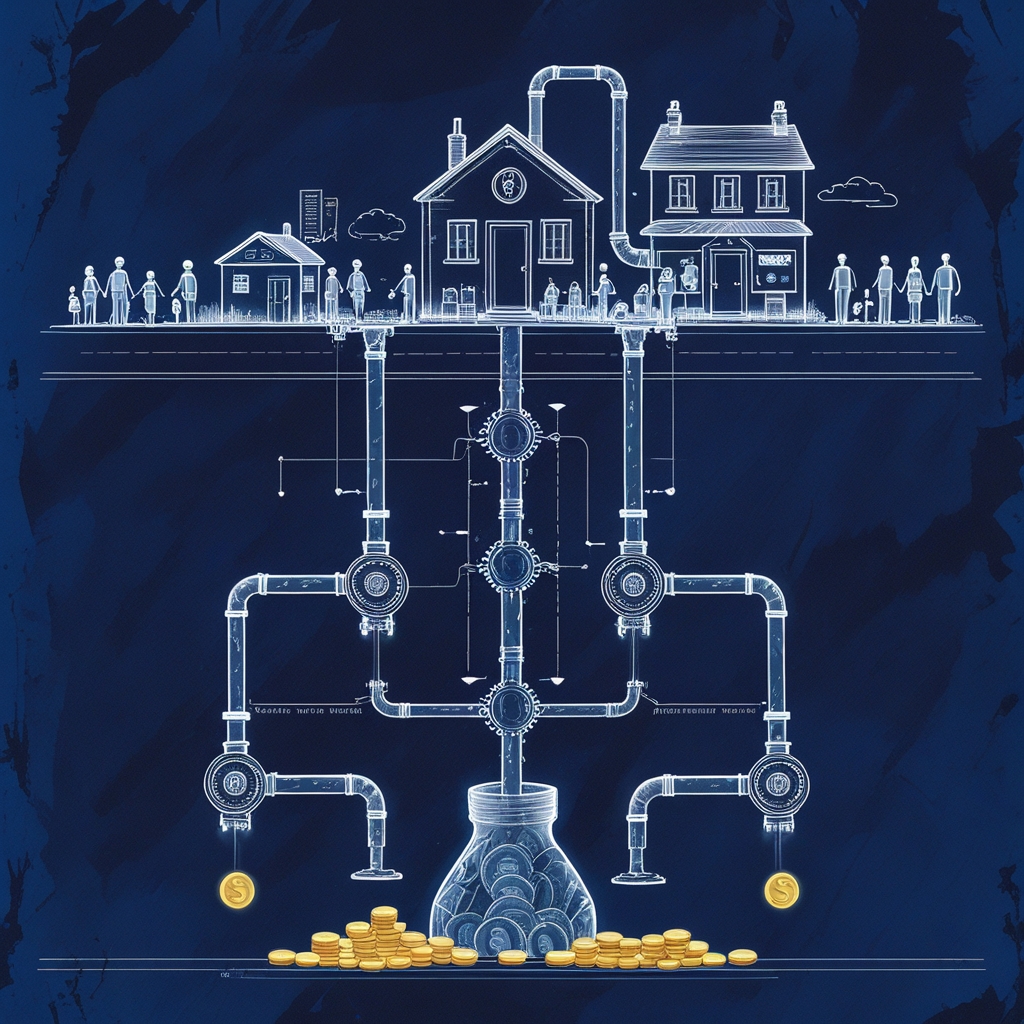
Start with the simplest example, a bathtub. The stock is the water in the tub. The inflow is the tap. The outflow is the drain. If the tap is running faster than the drain is draining, the stock increases, the water level rises. If the drain is draining faster than the tap is running, the stock decreases, the water level falls. And if the tap and the drain are balanced, the stock stays constant, the water level stays the same even though water is flowing in and out.
This is a basic stock-and-flow system, and it has properties that are not obvious until you think about them carefully. First, stocks change slowly. Even if you turn the tap on full, the bathtub does not fill instantly. It takes time. The flow is fast, but the stock is large, so it takes time for the flow to accumulate and change the stock. This is inertia. Stocks resist change because they accumulate gradually, and even fast flows take time to shift large stocks.
Second, stocks provide stability. The water level in the bathtub does not fluctuate wildly even if the tap or the drain varies slightly. The stock absorbs those variations. If the tap slows for a moment, the level drops slightly, but not catastrophically. If the drain clogs briefly, the level rises slightly, but not immediately overflows. The stock acts as a buffer, smoothing out short-term fluctuations in flows.
Third, stocks create delays. If you turn off the tap, the water does not disappear instantly. It drains, but it takes time. And during that time, the stock is still there, still having effects, still mattering. And if you turn the tap back on before the tub is empty, the stock starts rising again, and you might never see it empty. This delay between action and consequence, between changing a flow and seeing the stock change, is critical and is often misunderstood.
Now apply this to something more complex, your bank account. The stock is the balance. The inflows are salary, bonuses, gifts, investment returns. The outflows are rent, food, bills, entertainment, debt repayments. If inflows exceed outflows, your balance grows. If outflows exceed inflows, your balance shrinks. And if they are balanced, your balance stays constant.
But here is what most people miss: the balance, the stock, is what you see when you check your account. But the flows, income and spending, are what determine the balance. And flows can change quickly while stocks change slowly. You get a raise, your income flow increases, but your balance does not jump immediately. It grows, month by month, as the higher income accumulates. Or you start spending more, your outflow increases, but your balance does not crash immediately. It declines, gradually, as spending outpaces income.
And this delay creates problems. Because you see the stock, the balance, and you assume it is stable. You spend as if the balance will stay where it is. But if your spending exceeds your income, even slightly, the balance erodes. Slowly at first. Then faster. And by the time you notice, by the time the balance is low enough to alarm you, you have been overspending for months. And reversing it, increasing income or cutting spending enough to rebuild the balance, takes time. Because stocks change slowly.
Now apply this to populations. The stock is the number of people. The inflows are births and immigration. The outflows are deaths and emigration. If births exceed deaths, the population grows. If deaths exceed births, it shrinks. And if they are balanced, it stays constant.
But populations are large stocks, and even small changes in flows take decades to shift the stock significantly. If birth rates fall, the population does not shrink immediately. It keeps growing for decades because there are still more births than deaths, just fewer births than before. The stock has inertia. And by the time the population starts shrinking, decades have passed, and the age structure has changed, there are fewer young people and more old people, which creates new pressures, on pensions, on healthcare, on labor supply.
And because the delay between falling birth rates and shrinking population is so long, policymakers often fail to act. They see the population still growing and assume there is no problem. But the flows have already changed, and the stock will eventually follow. And when it does, it will be too late to reverse quickly because you cannot change a population overnight. You can change birth rates, through policy, through incentives, but it takes a generation for those changes to accumulate into a significantly different population size.
Now apply this to carbon in the atmosphere. The stock is the concentration of CO2. The inflows are emissions from burning fossil fuels, from deforestation, from industrial processes. The outflows are absorption by oceans, by forests, by soil. If emissions exceed absorption, the stock grows, CO2 concentration rises. If absorption exceeds emissions, it shrinks. And if they are balanced, it stays constant.
But the stock is enormous, and the outflows are slow. Oceans and forests absorb CO2, but not fast enough to match current emissions. So the stock is growing. And because the stock is large and the flows are relatively small compared to the stock, it takes decades for the stock to change significantly even if we cut emissions dramatically. If we stopped all emissions tomorrow, which is impossible, the CO2 concentration would not fall immediately. It would plateau, stay high for decades, because the outflows, natural absorption, are slow.
This is why climate change is so difficult. The stock, CO2 in the atmosphere, changes slowly. Even aggressive cuts to emissions, changes to the inflow, take decades to stabilize the stock. And the stock, the concentration, is what drives warming, drives feedback loops, drives impacts. So we are locked into decades of warming even if we act now, because the stock has already accumulated and will take decades to reduce.
And this is also why climate action feels futile to many people. They see emissions being cut, the flow decreasing, but they do not see the stock, the CO2 concentration, falling. It is still rising, just more slowly. And because the stock is still rising, the impacts are still worsening, and people think the cuts are not working. But they are working, they are slowing the growth of the stock, and eventually, if sustained, they will stabilize and then reduce it. But the delay between cutting emissions and seeing results is decades, and most people, most politicians, do not think in decades.
Now apply this to debt. The stock is the total debt, personal, corporate, or national. The inflows are new borrowing. The outflows are repayments. If borrowing exceeds repayments, debt grows. If repayments exceed borrowing, it shrinks. And if they are balanced, it stays constant.
But debt has another flow, interest. Interest is added to the stock, it increases the debt, and it is proportional to the stock. The larger the debt, the larger the interest, and the faster the stock grows even if you are not borrowing more. This is compounding. And compounding turns a slow-growing stock into a fast-growing one, because the flow, interest, increases as the stock increases, which increases the stock further, which increases the flow again. This is a reinforcing feedback loop, and it means that debt, if not managed, accelerates.
And repaying debt is slow because the stock is large and the outflow, repayments, is limited by income. If you owe fifty thousand pounds and can afford to repay one thousand pounds per year, it takes fifty years to clear the debt, assuming no interest. But with interest, the stock grows faster than you repay, and you never clear it. You are stuck. And the only way out is to increase the outflow, repay more, or to reduce the inflow, stop borrowing, or both. But both are difficult when income is limited and when expenses are high.
Now apply this to knowledge. The stock is what you know, what you have learned and retained. The inflows are learning, reading, studying, experiencing. The outflows are forgetting. If you learn faster than you forget, your knowledge grows. If you forget faster than you learn, it shrinks. And if they are balanced, it stays constant.
But knowledge is different from other stocks because the outflows, forgetting, are not always obvious. You do not see knowledge draining away like water from a bathtub. It happens slowly, imperceptibly, and you only notice when you try to recall something and cannot. And the inflows, learning, require effort, sustained effort, and most people stop learning actively after formal education ends. So the stock, knowledge, slowly decays, and people become less capable, less informed, less able to adapt, without realizing it.
And knowledge has another property, it can increase through use. Using knowledge reinforces it, makes it more accessible, more integrated. So the more you use what you know, the less you forget, and the more you can learn, because new knowledge builds on existing knowledge. This is a reinforcing loop. But it works in reverse too. The less you use knowledge, the more you forget, and the harder it becomes to learn new things, because you lack the foundation. This is why continuous learning matters, not just for acquiring new knowledge but for maintaining what you already have.
So here is why stocks and flows matter. Stocks change slowly, even when flows change quickly, which creates inertia and delays. Stocks provide stability, buffering against short-term fluctuations in flows. Stocks create persistence, what you build up or run down today affects you for years or decades. And stocks and flows interact through feedback loops, where the stock influences the flows, and the flows change the stock, and the cycle repeats.
Understanding stocks and flows changes how you analyze systems. Instead of focusing on snapshots, on the stock at a moment in time, you focus on dynamics, on how the stock is changing and why. Instead of reacting to the current level, you look at the flows, at what is adding and what is subtracting, and you intervene there. And instead of expecting instant results, you recognize that changing a stock takes time, and you plan accordingly.
And understanding stocks and flows reveals why so many interventions fail. Governments see high unemployment, a stock, and create job programs, trying to reduce the stock directly. But unemployment is determined by flows, people losing jobs and people finding jobs, and if the flows do not change, if people keep losing jobs faster than they find them, the stock will not fall. The intervention, creating a few jobs, is too small relative to the flows, and it has no lasting impact.
Or governments see high debt, a stock, and try to reduce it through austerity, cutting spending. But debt is also influenced by flows, by borrowing and by repayment and by interest, and if cutting spending reduces growth, it reduces income, which reduces tax revenue, which requires more borrowing, which increases debt. The stock does not fall, it rises, because the intervention changed the wrong flows.
Or parents see a child struggling in school, a stock of knowledge that is too low, and hire a tutor, trying to increase the inflow. But if the child is also forgetting rapidly, if the outflow is high because the material is not being reinforced or because the child is disengaged, the stock will not grow much. The tutoring adds knowledge, but it drains away as fast as it is added, and the net change is small.
Stocks and flows are everywhere. In every system. In every dynamic. And seeing them, understanding how they relate, how they change, and how they create behavior, is the foundation of systems thinking. Because once you see stocks and flows, you see structure. You see why systems resist change, why they have inertia, why they buffer shocks, and why they persist. And you see where to intervene, not at the stock, but at the flows, because flows are what change stocks, and changing flows is how you change systems.
The next article will take feedback loops, which we have mentioned but not fully explored, and show you how they work, how they interact, and how they drive the dynamics that make systems behave in ways that surprise, frustrate, and sometimes devastate us.