Where Systems Thinking Comes From
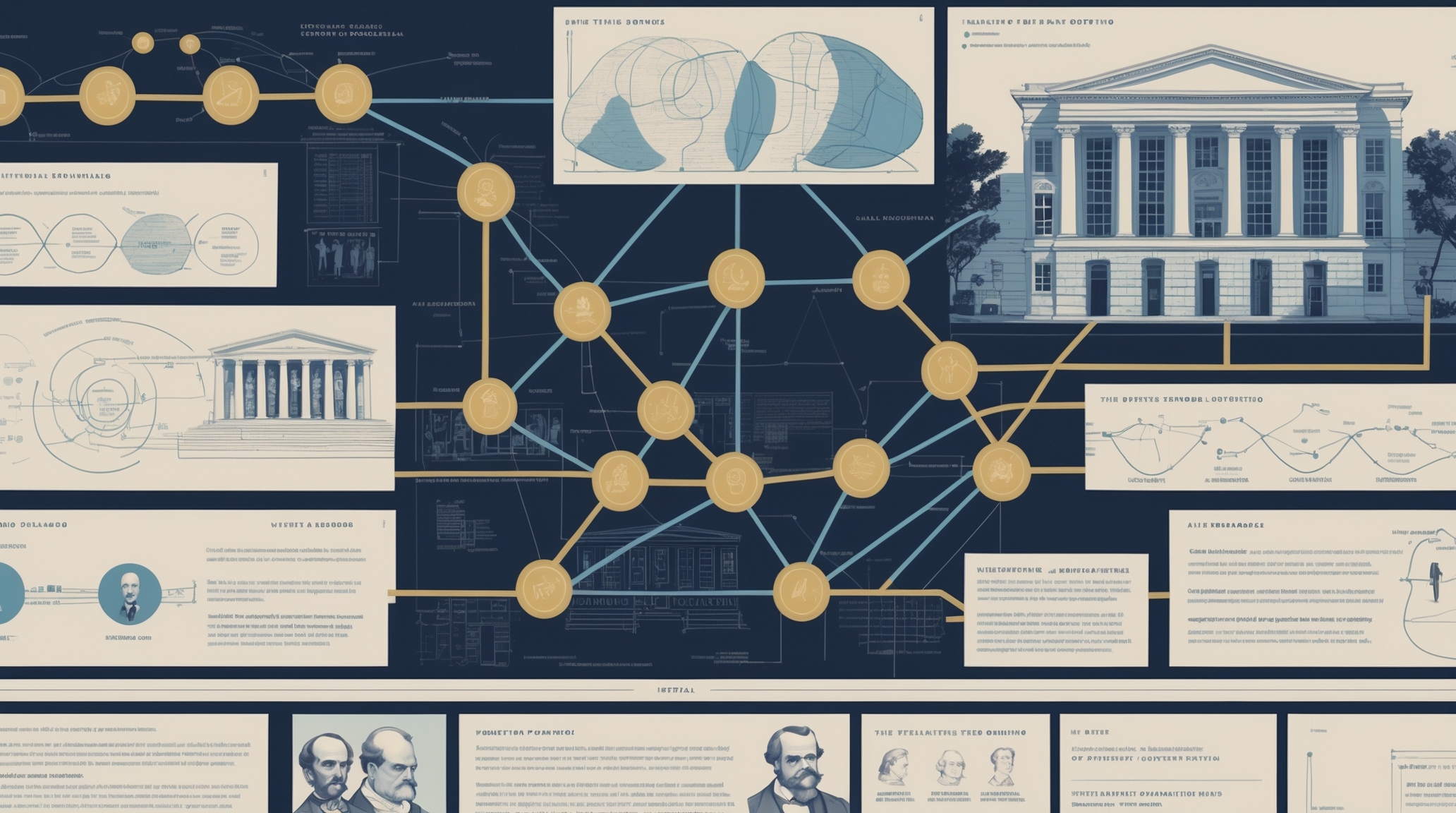
Systems thinking feels modern, feels like something new, something that emerged from computers and complexity and our interconnected world. But it is not new. It is old. Older than you think. The core ideas, the insights about feedback, about interconnection, about how changing one part of a system affects everything else, these ideas have been around for decades. Some for nearly a century. And they were developed not by philosophers or by social theorists, but by engineers, by biologists, by mathematicians trying to solve practical problems.
Understanding where systems thinking comes from matters because it shows that this is not just a perspective, not just a way of seeing. It is a discipline, grounded in science, tested in practice, and refined over generations. And it matters because the people who developed systems thinking were trying to solve the same problems we face today: how to understand complex systems that resist simple solutions, how to intervene in ways that actually work, and how to avoid the unintended consequences that come from acting without understanding structure.
Let me show you where systems thinking comes from and how it evolved into what we use today.
The story begins in the 1940s with cybernetics, a field that emerged during and after World War II when scientists and engineers were trying to build self-regulating machines. The most famous figure is Norbert Wiener, a mathematician at MIT, who was working on anti-aircraft gun systems that could track moving targets. The challenge was that you could not just point the gun at where the plane was, you had to predict where it would be by the time the shell arrived, and you had to adjust continuously as the plane maneuvered.
This required feedback, the gun system had to sense where the plane was, compare that to where it was aiming, calculate the error, and adjust. And this process had to repeat constantly, creating a loop where output fed back into input, which adjusted output, which fed back again. Wiener realized that this principle, feedback, was not just relevant to gun systems but to all kinds of systems, biological, mechanical, and social. And he wrote a book called Cybernetics in 1948 that laid out the mathematics and the theory of feedback and control.
Cybernetics gave us the language of feedback loops, of negative feedback that stabilizes systems and positive feedback that amplifies change. And it showed that feedback is everywhere, in thermostats that regulate temperature, in ecosystems where predator and prey populations balance, in economies where supply and demand adjust. The insight was profound: systems regulate themselves, not through central control but through feedback, and understanding feedback is essential to understanding behavior.
Around the same time, in the 1950s, a biologist named Ludwig von Bertalanffy was developing General Systems Theory. Bertalanffy was frustrated with the reductionism of traditional science, which studied systems by breaking them down into parts and analyzing each part in isolation. He argued that this approach missed something essential, that systems had properties that emerged from the interactions between parts, properties that you could not understand by studying the parts alone.
Bertalanffy proposed that there were principles that applied to all systems, whether biological, physical, or social. Principles like openness, where systems exchange energy and matter with their environment. Like hierarchy, where systems are nested within larger systems. Like equifinality, where systems can reach the same end state from different starting points through different paths. And he argued that these principles could provide a unified framework for understanding complexity across disciplines.
General Systems Theory did not provide tools or methods, it was more philosophical than practical, but it established the idea that systems, regardless of what they were made of, shared common structures and behaviors. And it created a community of researchers who were interested in applying systems ideas to fields as diverse as ecology, psychology, management, and urban planning.
In the 1960s, Jay Forrester, an engineer also at MIT, took systems thinking in a more practical direction by developing System Dynamics. Forrester had worked on early computers and on control systems, and he became interested in applying engineering principles to social and economic problems. He started with industrial systems, looking at supply chains and inventory management, and he discovered that many problems, like boom-and-bust cycles in production, were caused not by external shocks but by the internal structure of the system, by feedback loops and delays that created oscillations.
Forrester built computer models to simulate these systems, using stocks and flows to represent accumulation and change, and using feedback loops to show how variables influenced each other over time. And he showed that you could use these models to test policies, to see what would happen if you changed a rule or adjusted a parameter, and to identify leverage points where small interventions could have large effects.
System Dynamics became a tool, not just a theory, and it was applied to urban planning, to corporate strategy, and eventually to global issues. And Forrester trained a generation of students who spread System Dynamics to universities, to corporations, and to policy organizations around the world.
The most famous application of System Dynamics came in 1972 with a book called The Limits to Growth, commissioned by the Club of Rome, an international think tank concerned about the future of humanity. The book, written by a team led by Donella Meadows, Dennis Meadows, and Jørgen Randers, used a System Dynamics model to simulate the interactions between population, industrial production, food production, resource depletion, and pollution.
The model showed that if current trends continued, if population and industrial production kept growing exponentially while resources were finite, the world would hit limits sometime in the twenty-first century. Growth would stop, not smoothly but abruptly, through collapse, either from resource depletion, from pollution, or from both. The message was stark: infinite growth on a finite planet is impossible, and continuing to pursue growth without understanding the system would lead to disaster.
The Limits to Growth was controversial, it was attacked by economists and politicians who rejected the idea that growth could not continue forever, and many of its specific predictions were debated. But its core insight, that exponential growth in a finite system creates overshoot and collapse, was sound, and the book introduced millions of people to the idea that economic and environmental systems are interconnected and that ignoring feedback loops and limits leads to catastrophic outcomes.
Donella Meadows became one of the most influential systems thinkers of the late twentieth century. She was not just a modeler, she was a communicator, and she wrote clearly and accessibly about systems, about leverage points, about why our intuitions about cause and effect so often fail us. Her essay Leverage Points: Places to Intervene in a System is one of the most widely read pieces on systems thinking, and it laid out a hierarchy of interventions, from weak leverage points like adjusting parameters to strong leverage points like changing the goals of the system or transcending paradigms entirely.
Meadows taught that most policy interventions fail because they target weak leverage points, they tweak numbers, they adjust subsidies, they change regulations slightly, but they do not change the structure, the feedback loops, the goals, or the paradigms that drive behavior. And she argued that real change, transformative change, requires understanding where power lies in a system and intervening at the points where structure can actually shift.
In the 1990s, Peter Senge brought systems thinking into the business world with his book The Fifth Discipline. Senge argued that organizations are systems, and that most organizational problems, poor performance, internal conflict, failure to adapt, are caused by a failure to see the system. Managers focus on events, on immediate crises, and they react without understanding the deeper structures that create those crises. And this creates a pattern where the same problems recur, where solutions fail, and where organizations get stuck.
Senge introduced the idea of the learning organization, an organization that understands systems, that sees feedback loops, that recognizes delays, and that tests its assumptions rather than reacting blindly. And he popularized tools like causal loop diagrams, system archetypes, and mental models, making systems thinking accessible to managers, consultants, and leaders who were not engineers or scientists.
The Fifth Discipline was hugely influential in corporate settings, and it brought systems thinking to a much wider audience. But it also diluted some of the rigor, and in the hands of consultants and MBA programs, systems thinking sometimes became a buzzword, a checklist of tools rather than a deep understanding of structure and dynamics.
Today, systems thinking is applied across fields. In climate science, where feedback loops between temperature, ice melt, carbon emissions, and vegetation determine whether we stabilize or spiral into runaway warming. In public health, where understanding how diseases spread, how behaviors change, and how interventions interact is essential for controlling epidemics. In economics, where financial crises, inequality, and unsustainable growth are all systems problems that cannot be solved with linear, reductionist thinking. And in policy, where every major challenge, housing, healthcare, education, energy, involves complex systems with multiple feedback loops, delays, and unintended consequences.
Systems thinking has become essential because the problems we face are systems problems. Climate change is not just about emissions, it is about feedback loops between energy systems, economic growth, political power, and ecological tipping points. Inequality is not just about wages, it is about feedback loops between wealth concentration, political influence, educational access, and opportunity. And healthcare, housing, pensions, all the systems we have analyzed, are complex, interconnected, and resistant to simple fixes.
What makes systems thinking powerful is that it gives us tools to see structure, to understand why problems persist, and to identify where intervention can actually shift outcomes. It shows us that events are symptoms, that focusing on events without understanding the underlying structure is futile, and that real change requires seeing the loops, the delays, the goals, and the paradigms that shape behavior.
And systems thinking shows us that our intuitions, our linear cause-and-effect thinking, often fail us. We think that if we push harder, we will get more results, but in systems with feedback loops, pushing harder can make things worse. We think that if we fix one part, the whole system will improve, but in interconnected systems, fixing one part can create new problems elsewhere. And we think that complex systems require complex solutions, but often the most effective interventions are simple, they just need to be targeted at the right leverage point.
So here is where systems thinking comes from. From Norbert Wiener and cybernetics, which gave us feedback loops and the mathematics of control. From Ludwig von Bertalanffy and General Systems Theory, which gave us the idea that all systems share common principles. From Jay Forrester and System Dynamics, which gave us the tools to model and simulate complex systems. From The Limits to Growth and Donella Meadows, which showed us that exponential growth on a finite planet leads to collapse and taught us about leverage points. From Peter Senge and The Fifth Discipline, which brought systems thinking to organizations and made it accessible to non-specialists. And from decades of application across climate, health, economics, and policy, which have shown that systems thinking works, that it reveals structure, and that it improves outcomes.
This is not just theory, this is not just philosophy, this is science, tested and refined over nearly a century. And understanding where it comes from gives us confidence that when we use systems thinking to analyze housing, healthcare, pensions, energy, childcare, we are standing on solid ground. We are using tools that have been proven, that have been applied to the hardest problems humanity faces, and that work.
The next article will go deeper into stocks and flows, the fundamental building blocks of every system. Because understanding how things accumulate, how they change, and why they change slowly even when we want them to change fast, is essential to understanding why systems behave the way they do.