Feedback Loops: How Systems Reinforce Themselves
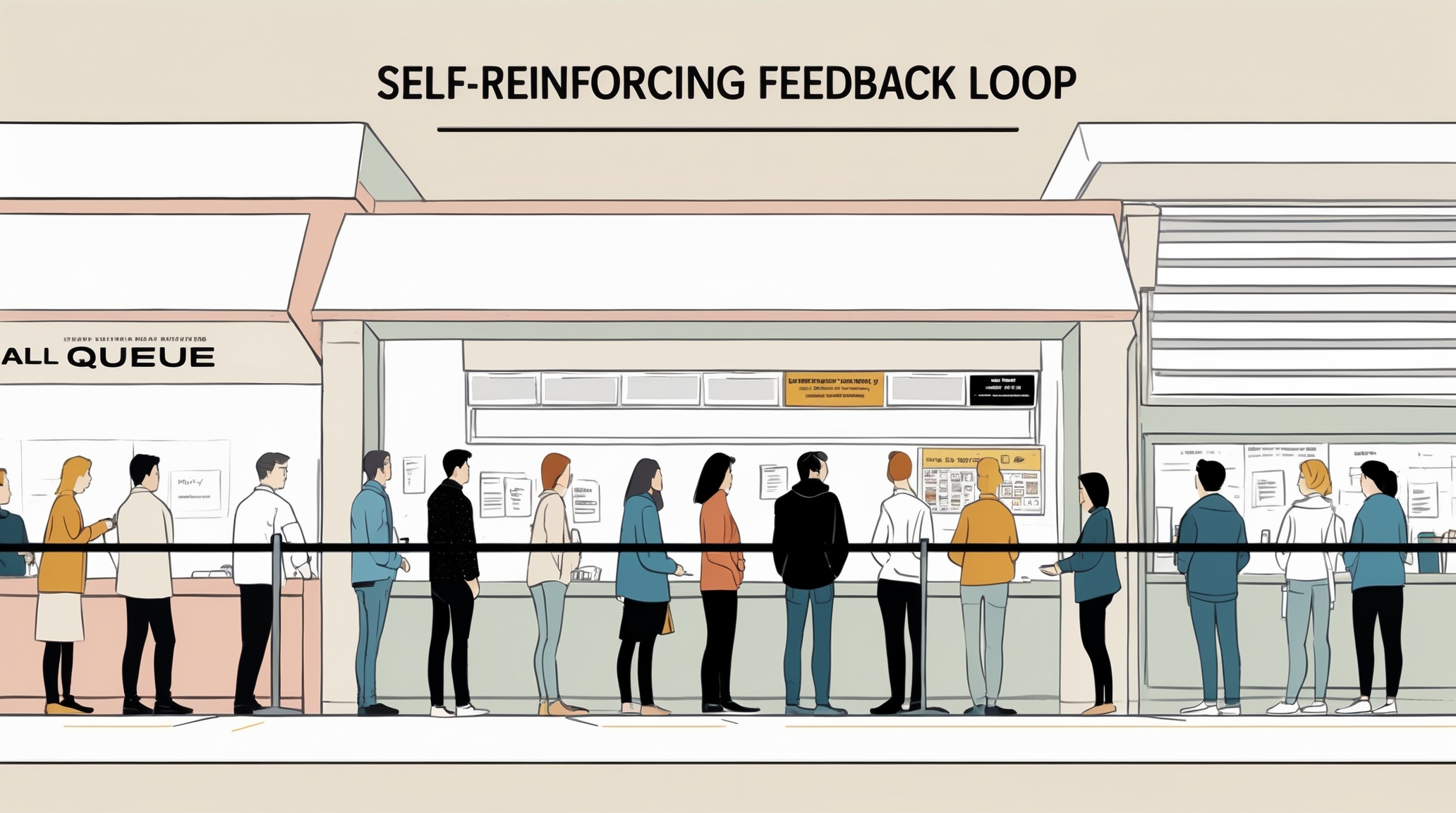
Imagine you are standing in a queue at a coffee shop. It is moving slowly. Really slowly. The person at the front is taking forever to decide what they want. You can feel the frustration building behind you. People start checking their phones, sighing, shifting their weight. And then something happens.
The barista, feeling the pressure of the long queue, starts rushing. They make mistakes. An order gets mixed up. Someone asks for it to be remade. Now the queue is moving even slower. More people join the back of the line because from the outside it still looks like a popular place. The queue gets longer. The barista rushes more. More mistakes happen. The cycle continues.
Nobody planned this. Nobody wanted it. But the system has locked itself into a loop. The slower the queue moves, the more pressure there is. The more pressure there is, the more mistakes get made. The more mistakes get made, the slower the queue moves. Round and round it goes, reinforcing itself with every turn.
This is a feedback loop. And once you learn to see them, you will notice they are everywhere.
A feedback loop is what happens when the output of a system becomes the input. When the result of an action feeds back into the system and changes what happens next. Sometimes that makes things better. Often, it makes things worse. But either way, the system is no longer static. It is dynamic. It is responding to itself.
There are two kinds of feedback loops, and understanding the difference between them is one of the most important things you can learn about how systems work.
The first kind is a reinforcing loop. This is the kind that amplifies. Whatever is happening, it makes more of it happen. If something is growing, it grows faster. If something is declining, it declines faster. Reinforcing loops are engines of change. They accelerate. They compound. They spiral.
Think about confidence. If you feel confident, you are more likely to take risks. When you take risks and they pay off, your confidence grows. So you take bigger risks. And if those pay off, your confidence grows even more. Success breeds confidence. Confidence breeds success. The loop reinforces itself upward.
But it works the other way too. If you lose confidence, you hesitate. When you hesitate, you miss opportunities. When you miss opportunities, your confidence drops further. So you hesitate more. Failure feeds doubt. Doubt feeds failure. The loop reinforces itself downward.
Neither of these loops is good or bad on its own. They are just mechanisms. But they are powerful mechanisms. Because once a reinforcing loop gets moving in one direction, it becomes very hard to stop. Momentum builds. Small advantages compound into large ones. Small setbacks spiral into larger ones. The system amplifies whatever direction it is already heading.
This is why the rich get richer. Money makes money. If you have capital, you can invest it. The returns give you more capital. So you invest more. Your wealth grows faster than someone who is starting from zero. It is not just hard work or talent. It is a reinforcing loop that accelerates inequality without anyone actively choosing it.
This is also why queues at popular restaurants get longer. The restaurant is popular, so it has a queue. The queue signals to passersby that the restaurant must be good. So more people join the queue. The queue gets longer. The signal gets stronger. More people join. The loop feeds itself.
Or think about housing markets. Prices start to rise in a desirable area. People notice. Investors buy properties expecting further rises. Demand increases. Prices rise faster. More investors pile in. The loop accelerates. Until, eventually, something breaks and the loop reverses just as violently in the other direction.
Reinforcing loops do not care about sustainability. They do not self-correct. They just amplify. And if left unchecked, they drive systems toward extremes.
Now, the second kind of feedback loop is a balancing loop. This is the kind that stabilises. It pushes back. It resists change. If something is growing too fast, it slows it down. If something is falling too far, it pulls it back up. Balancing loops are the systems equivalent of a thermostat. They regulate. They maintain equilibrium.
Think about your body temperature. If you get too hot, you sweat. Sweating cools you down. If you get too cold, you shiver. Shivering generates heat. Your body is constantly adjusting, constantly correcting, constantly trying to stay in balance. That is a balancing loop.
Or think about supply and demand. If a product is in high demand and low supply, the price goes up. The higher price reduces demand and encourages more supply. Eventually, the market stabilises. Price acts as the balancing mechanism that prevents the system from spiralling out of control in either direction.
Balancing loops sound sensible. Stabilising. Safe. But here is the thing. They are also what makes systems resistant to change. Because a balancing loop does not just resist bad change. It resists all change. It pushes back toward the current state, whatever that state is. Even if the current state is broken.
Think about someone trying to change a habit. Let us say they want to wake up earlier. For the first few days, they set an alarm and drag themselves out of bed. But their body is used to a certain sleep pattern. It pushes back. They feel exhausted during the day. Their energy drops. They go to bed later to compensate. The alarm feels harder to respond to. Eventually, they slip back into the old routine. The system has balanced itself back to where it started. Not because the person failed, but because the balancing loop was stronger than their effort.
Or think about organisations. A new leader comes in with ideas for change. But the organisation has routines, relationships, unwritten rules that have been in place for years. People resist, not out of malice, but because the system is wired to maintain stability. Meetings get rescheduled. Decisions get delayed. Old habits reassert themselves. The balancing loop pulls everything back toward the familiar. Change is hard not because people are stubborn, but because systems are designed to resist it.
Now here is where it gets interesting. Most real-world systems are not just one loop or the other. They are multiple loops interacting. Some reinforcing. Some balancing. And the behaviour of the system depends on which loop is dominant at any given time.
Take a pandemic. Early on, infection is a reinforcing loop. One person infects two. Those two infect four. Four infect eight. The numbers grow exponentially. But then balancing loops kick in. People start distancing. Immunity builds. Resources get mobilised. The reinforcing loop slows. The system stabilises. Understanding which loop is driving the system at which point tells you what kind of intervention will actually work.
Or think about social media. Engagement is a reinforcing loop. The more people interact with a post, the more it gets shown. The more it gets shown, the more people interact. Viral content explodes because the loop is running unchecked. But platforms also have balancing mechanisms. Algorithms detect spam. Users get fatigued. Attention shifts. The loop eventually slows. But while it is active, it is incredibly powerful.
Here is the key insight. If you want to change a system, you need to know which loops are operating and whether they are reinforcing or balancing. Because the strategy is different depending on which one you are dealing with.
If you are facing a reinforcing loop that is spiralling in a bad direction, you need to break the loop. Interrupt the cycle. Stop the output from feeding back into the input. If debt is compounding, stop borrowing. If panic is spreading, stop amplifying the signal. Cut the feedback path.
If you are facing a balancing loop that is resisting change you want, you need to weaken the loop or introduce a stronger force. Make the old behaviour harder. Make the new behaviour easier. Shift the point of balance so the system stabilises somewhere new instead of pulling back to where it was.
And if you want to create change that lasts, you need to build a new reinforcing loop in the direction you want to go. Small wins that build confidence. Confidence that leads to bigger wins. Success that generates momentum. Let the loop do the work for you instead of fighting it.
This is how systems sustain themselves. Not through static rules, but through dynamic loops that either amplify or stabilise behaviour. And once you see the loops, you stop being surprised by why things stay stuck or why they spiral out of control.
You start seeing the engine underneath the outcome.
And that is when you can finally intervene in a way that actually sticks.