Why Complex Systems Resist Control
You have a problem. You know what is causing it. You know what needs to change. So you design a solution. A good one. Thought through. Logical. You implement it. And then you wait for the results.
Except the results are not what you expected. The problem does not go away. Or it goes away in one place and shows up somewhere else. Or it gets worse. Or something completely unexpected happens that you never saw coming. And you are left wondering: what went wrong?
Nothing went wrong. You just tried to control a complex system.
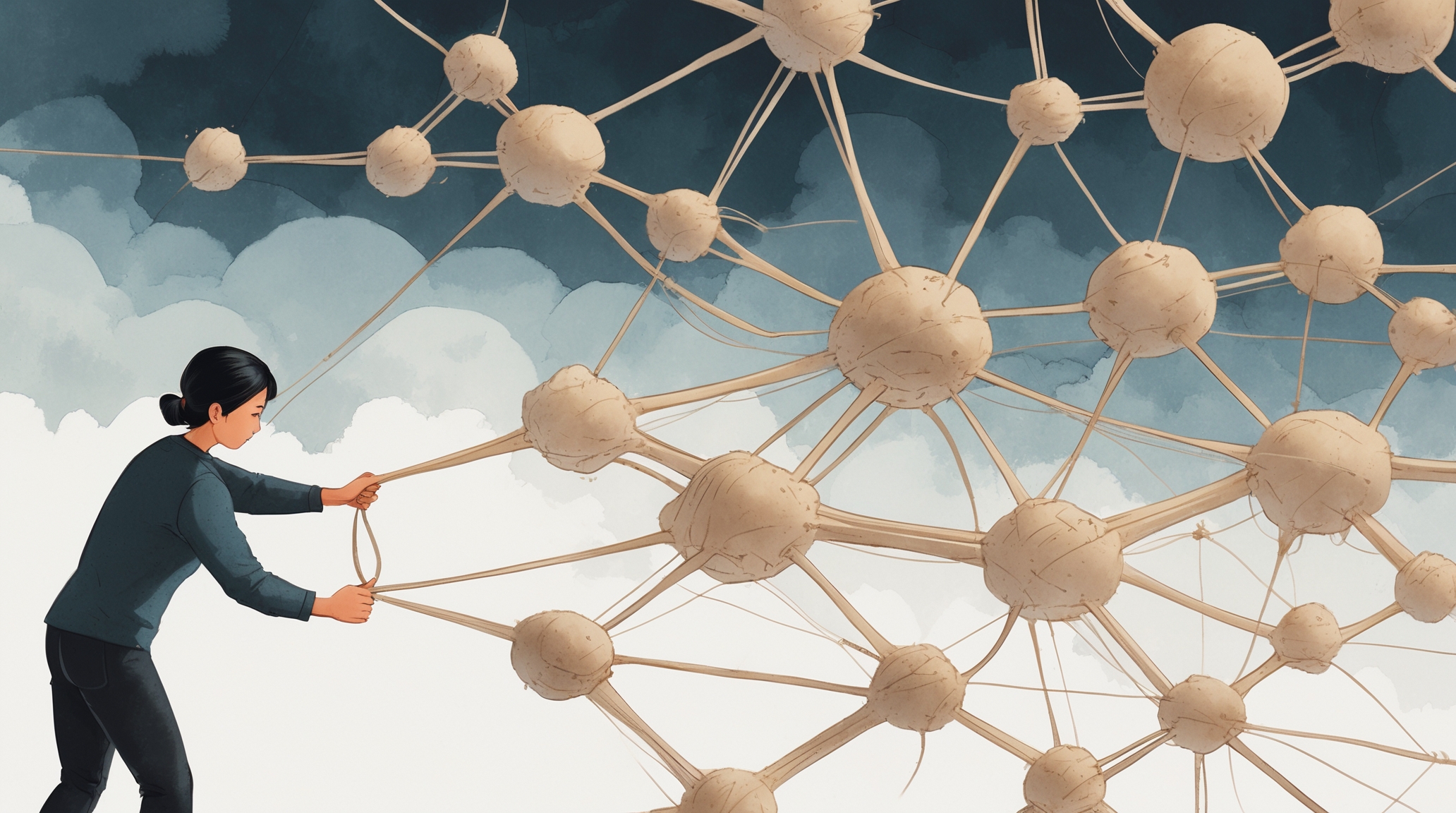
Here is the thing about complex systems. They do not behave the way you expect them to. They do not respond to simple cause and effect. Push here, and something happens over there. Fix this, and that breaks. Solve one problem, and three new ones appear. It is not that your solution was bad. It is that the system is not a machine. It is a web. And webs do not respond well to being pulled in one direction.
Let me give you an example. A city has a traffic problem. Too many cars. Congestion everywhere. So the city builds more roads. More lanes. Wider motorways. The logic is simple. More road capacity means more space for cars, which means less congestion. Problem solved.
Except it does not work that way. At first, traffic improves. The new roads are open, fast, smooth. But then something strange happens. More people start driving. People who used to take public transport switch to cars because driving is now easier. People who used to avoid certain routes now take them because the roads are better. Within a few years, congestion is back. Sometimes worse than before. The city has just spent millions making the problem bigger.
This is called induced demand. And it is a perfect example of why complex systems resist control. The solution you implemented changed the system in ways you did not predict. It created new feedback loops. It shifted incentives. It altered behaviour. And the system adapted around your intervention in ways that undermined the very thing you were trying to achieve.
Or think about a different example. A government wants to reduce unemployment. So it introduces a benefit system that pays people while they look for work. The intention is good. Give people support so they can find the right job instead of taking the first bad one out of desperation. But then an unintended consequence emerges. Some people stay on benefits longer than they need to because the threshold for losing support is sharp. Earn slightly too much, and you lose everything. So there is a disincentive to take low-paid or part-time work. The system, designed to help people into employment, has accidentally created a trap that keeps some of them out. Nobody planned that. But the structure produced it anyway.
This is not about bad intentions. It is about complexity. Complex systems have multiple parts, and those parts interact in ways that are not always obvious. Change one part, and the effects ripple outward. Sometimes in the direction you want. Often in directions you did not anticipate. And sometimes, those ripples come back and cancel out the very change you made.
Here is why this happens. Complex systems are not linear. In a linear system, cause and effect are direct. You push a button, a light turns on. You turn a dial, the temperature changes. Input leads to output in a predictable way. But complex systems are full of feedback loops, delays, and interconnections. The output of one part becomes the input of another. Actions taken now produce effects later. And those effects loop back and change the conditions that led to the action in the first place.
This means that the system is always responding to itself. It is dynamic. It is adaptive. And it does not sit still while you try to control it.
Think about a workplace. Management sees that productivity is low, so they introduce a new monitoring system. Employees now have to log their time, report their tasks, justify their hours. The logic is that visibility will drive accountability, and accountability will drive performance. But what actually happens? Employees start gaming the system. They log tasks that look productive but are not. They spend time reporting instead of working. Trust erodes. Morale drops. Productivity falls further. The system adapted to the intervention, but not in the way that was intended.
Or think about ecosystems. A farmer has a pest problem. Insects are eating the crops. So the farmer introduces a pesticide. The pests die. Problem solved. Except the pesticide also kills the insects that were eating the pests. Now the pest population has no natural predators. So when the pesticide wears off, the pests come back stronger than before. The system was more interconnected than it looked. The solution disrupted a balance that was keeping things in check.
This is the core problem with trying to control complex systems. You can see the part you are trying to fix. But you cannot see all the connections. You cannot predict every interaction. And you cannot control how the system will adapt once you intervene.
Here is another layer. Complex systems have delays. You make a change, and nothing happens immediately. So you think it did not work. So you make another change. Then another. And then, months later, all three changes hit at once, and the system lurches in a direction nobody wanted. The delay between action and consequence makes it almost impossible to know what caused what. And by the time you realise something has gone wrong, you have already made five more changes that are now baked into the system.
Think about a diet. You change your eating habits, but you do not see results on the scale for weeks. So you assume it is not working, and you change your approach again. Then again. By the time your body starts responding to the first change, you are three strategies ahead, and you have no idea which one is actually working. The delay broke the feedback loop that would have told you what to do.
Or think about policy. A government introduces an education reform. It takes years to see the effects. By that time, there has been a new government, new priorities, new reforms. Nobody knows if the original change worked because the system never had time to stabilise before the next intervention. The delay between action and result makes learning almost impossible.
So what do you do? If you cannot control a complex system, does that mean you just give up? Do nothing? Hope for the best?
No. It means you change your approach. You stop trying to control and start trying to influence. You stop looking for the one perfect solution and start experimenting with small, reversible changes that give you feedback. You stop designing interventions from the top down and start working with the system to see where it wants to go.
Here is what that looks like in practice. Instead of building more roads, a city experiments with congestion pricing in one area. It is small. It is reversible. And it gives you data. Does behaviour change? Do people shift to public transport? Does traffic flow improve? You learn from that before scaling it. You let the system tell you what works instead of assuming you know.
Instead of imposing a new monitoring system across an entire workplace, you pilot it with one team. You watch what happens. You ask the people inside the system how it is affecting them. You adjust based on what you learn. You treat the intervention as an experiment, not a decree.
Instead of applying pesticide across an entire farm, you try integrated pest management in one field. You introduce natural predators. You rotate crops. You observe. You iterate. You work with the ecosystem instead of trying to overpower it.
This is the shift that systems thinking asks you to make. From control to influence. From certainty to experimentation. From top-down solutions to adaptive interventions.
Because complex systems do not obey commands. They respond to nudges. They adapt to incentives. They evolve around constraints. And the only way to work with them effectively is to respect their complexity, to move slowly enough to see the consequences of your actions, and to be humble enough to change course when the system shows you something you did not expect.
You cannot control a complex system. But you can learn to dance with it. You can listen to its feedback. You can test your assumptions. You can intervene gently and watch what happens. And over time, you can guide it in a direction that works.
But only if you stop pretending you can predict every outcome. Only if you accept that some consequences will surprise you. And only if you are willing to adapt when they do.
Because the systems you are trying to change are not machines. They are living, breathing, interconnected webs of cause and effect. And they will always be smarter than your plan.
The question is whether you are smart enough to notice when they push back.