The Question: Why Can't I Find Anywhere To Live After My Landlord Lost The Property? (Article 2)

In the first part of this series we looked at why landlords are being repossessed despite tenants paying their rent — and how the interest-only mortgage structure built during a decade of low interest rates stopped working when rates rose. If you haven't read that piece first, it is worth doing so because this one picks up exactly where it left off.
You have received your notice. The landlord has lost the property. Now you need somewhere to live. And this is where the second layer of the problem begins — one that is just as structural as the first, and just as invisible until you find yourself inside it.
The market you are entering
The rental market you are now searching in is not the same one that existed five or ten years ago. Supply has been falling as landlords exit — many of them for exactly the reasons described in part one. Demand has been rising as people who might previously have bought their own home remain priced out of ownership. The result is more tenants competing for fewer properties, which means landlords and their agents can be selective in ways they could not have been when the market was more balanced.
You are not entering a market. You are entering a queue, and the queue has an invisible ranking system.
What a landlord actually sees when you apply
When you apply for a rental property the letting agent or landlord will ask for references and bank statements — typically three to six months of them. This is standard practice and it is where the hidden filtering begins.
Your bank statements tell a story. They show your income, where it comes from, how regular it is, and what you spend it on. A landlord reviewing six applications will see some statements showing a regular monthly salary from an employer, and some showing Universal Credit payments, part-time income, or irregular earnings. The law is clear — it is unlawful to refuse a tenancy solely on the grounds that an applicant receives Universal Credit or housing benefit. But the law cannot compel a landlord to choose you. It can only prevent them from stating the reason they did not.
In practice a landlord reviews the applications, selects the one they consider lowest risk, and the person with a full-time salary and clean statements gets the property. The person on Universal Credit does not get a rejection letter explaining the decision. They simply do not get a call back. Nothing illegal has happened on paper. The mechanism has done its work invisibly.
Why Universal Credit makes the problem worse
Universal Credit is paid monthly in arrears. There is typically a five-week wait for the first payment when someone makes a new claim — a structural feature of the system that was built into it by design, intended to mirror the experience of employment. For someone who has just lost their home and needs to pay a deposit and first month's rent immediately, a five-week wait is not an administrative inconvenience. It is a barrier that makes securing a new tenancy before the current one expires extremely difficult.
Housing benefit within Universal Credit is also capped at the Local Housing Allowance rate, which is set at the 30th percentile of local rents — meaning it is designed to cover only the cheapest thirty percent of available properties in an area. In most of London and large parts of the south of England the gap between the allowance and actual market rents means that Universal Credit claimants are mathematically excluded from the majority of available properties regardless of anything a landlord decides.
Where people end up
Those who cannot secure a new private tenancy present to their local council as homeless or threatened with homelessness. Councils have a legal duty to assist, but the temporary accommodation they can offer is under severe pressure. In London in particular, councils are placing families in temporary accommodation outside the borough — sometimes outside the city entirely — because nothing closer is available or affordable.
Children's schooling is disrupted. Commutes to work become unmanageable. The disruption feeds into reduced employment stability, which feeds back into the financial picture that made the original tenancy application harder in the first place.
The full picture
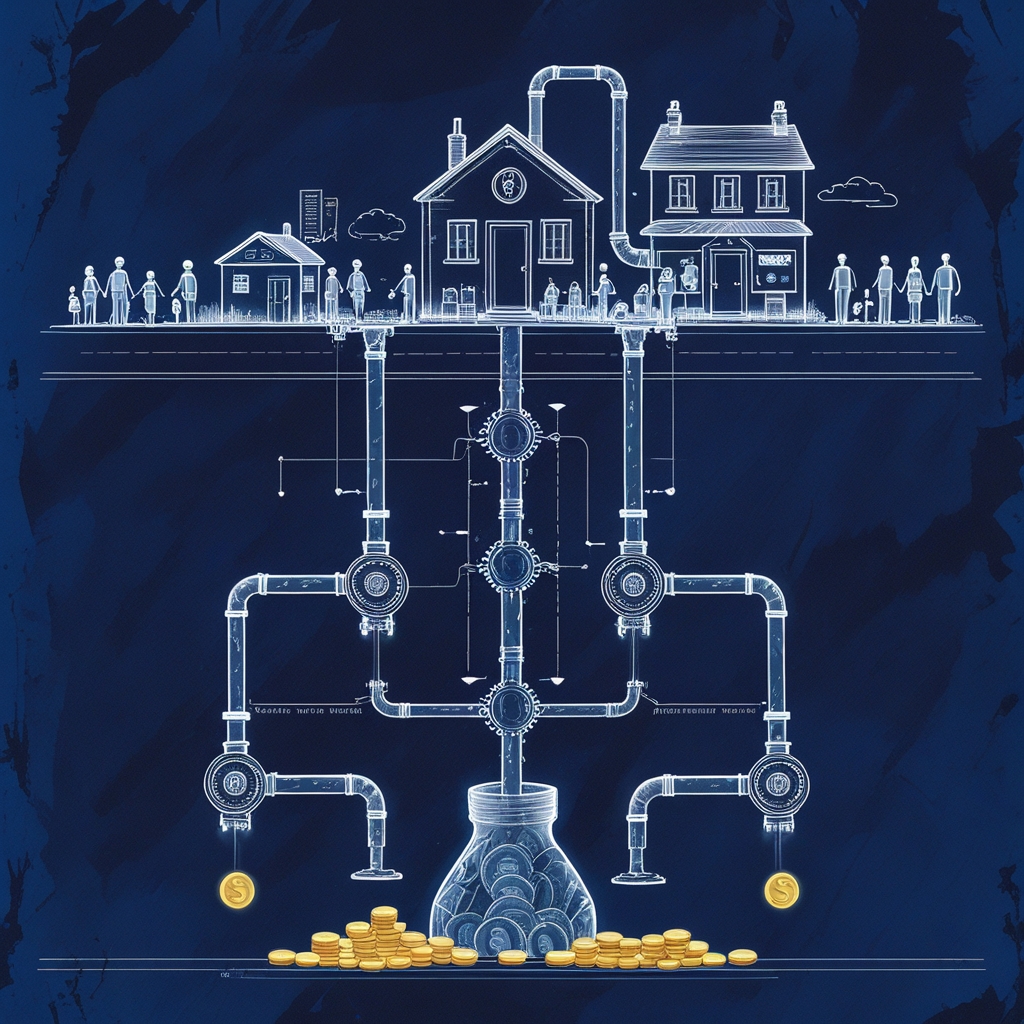
Take a step back and look at what has happened. A decision made in a Bank of England committee room — to raise interest rates in response to inflation — has travelled through the buy-to-let mortgage market, through a landlord's financial calculations, through a Section 21 notice, through a letting agent's application review, through the Universal Credit system, and arrived at a family in temporary accommodation in an unfamiliar part of the city.
Each step looked like a separate problem. A mortgage issue. A housing issue. A welfare issue. A homelessness issue. But it is one chain, and the links were forged long before the family ever received their notice to leave.
Understanding that chain does not make it easier to navigate. But it does mean you are no longer confused about why it is happening — and that is where the ability to respond to it, rather than simply be overwhelmed by it, begins.
*Source: Shelter England — https://england.shelter.org.uk/housing_advice/eviction
*Source: Gov.uk Universal Credit housing costs — https://www.gov.uk/universal-credit/housing-costs