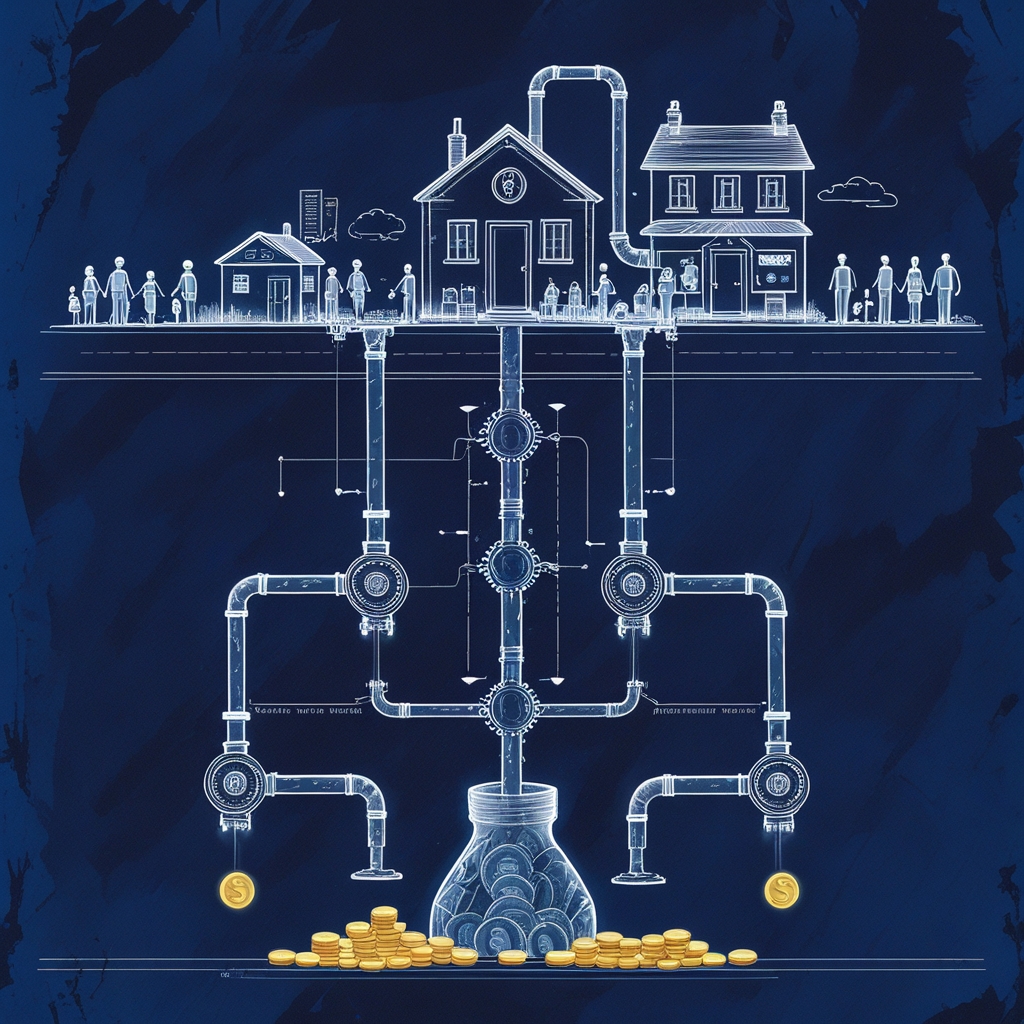
The Machine: How UK Leasehold Works

Leasehold operates through a split between ownership and occupation that creates extraction mechanisms at every level. The freeholder owns the land and building. You own a time-limited right to occupy. This split enables rent extraction, subordination, and wealth transfer that continue for the lease duration. Understanding the machine's components reveals how ordinary people paying full market prices end up in arrangements resembling tenancy more than ownership.
The Ownership Split
When you buy a leasehold property, you purchase a wasting asset. Your lease has a fixed term, typically ninety-nine, one hundred and twenty-five, or nine hundred and ninety-nine years at creation. Every day that passes reduces your remaining lease length. A ninety-nine year lease becomes a ninety-eight year lease, then ninety-seven, declining annually until it expires. When the lease expires, your right to occupy ends. The property reverts to the freeholder. You lose everything.
The freeholder owns the land and building in perpetuity. Their ownership never expires. They own the freehold title, the permanent interest in the property. Your leasehold is carved out of their freehold. You hold derivative rights granted by them. They remain the ultimate owner. You are subordinate.
This creates a fundamental power imbalance. The freeholder can wait. Time favors them. As your lease shortens, your asset depreciates. When your lease drops below eighty years, mortgage lenders become nervous. Below sixty years, properties become difficult or impossible to sell. Below thirty years, properties are virtually worthless regardless of building condition. The freeholder's ownership never diminishes. Your ownership declines automatically.
The split means you pay full market price for partial, temporary ownership while someone else retains permanent ownership and extracts rent from you for the privilege of occupying property you paid for. This is the foundational mechanism enabling everything else.
Ground Rent Extraction
Ground rent is payment to the freeholder for nothing. It provides no service. It grants no benefit. It is pure rent extraction based on the freeholder owning land you occupy. You pay annually, typically fifty to five hundred pounds, though some ground rents reach thousands. This money disappears. It builds no equity. It maintains nothing. It transfers wealth from you to the freeholder simply because they own and you lease.
Modern ground rent serves no legitimate purpose. Historically, ground rent represented land value separate from building value. Landowners leased land to builders who constructed buildings. Ground rent compensated landowners for land use. But contemporary leasehold properties are sold at full market value including both land and building. Buyers pay complete market price. Ground rent is additional extraction on top of purchase price, not compensation for land value excluded from the price.
Doubling ground rent clauses make this extraction worse. Some leases specify ground rent doubles every ten or twenty-five years. Fifty pounds becomes one hundred pounds, then two hundred, four hundred, eight hundred. After fifty years, fifty pounds ground rent becomes sixteen hundred pounds annually. After seventy-five years, twelve thousand eight hundred pounds. The doubling continues regardless of your income, property value changes, or ability to pay. This is contractual wealth extraction operating automatically.
Doubling ground rent makes properties unmortgageable. Mortgage lenders refuse loans on properties with doubling ground rent because future costs become unpredictable and potentially unaffordable. Properties become unsellable because buyers cannot get mortgages. Leaseholders are trapped in properties losing value with no escape route. Freeholders profit from ground rent while leaseholders watch their assets become worthless.
Government banned ground rent on new leases from June twenty twenty-two. But four point nine eight million existing leaseholders still pay ground rent. The ban helps future buyers. It does nothing for those already trapped. Freeholders continue extracting billions annually from existing leaseholders. The ban acknowledges ground rent serves no legitimate purpose while leaving millions paying it indefinitely.
Service Charge Inflation
Service charges cover building maintenance, repairs, insurance, management fees, and communal area upkeep. These are necessary costs for multi-unit buildings. But the structure allows systematic inflation beyond what services cost and what leaseholders can control.
Managing agents administer service charges on behalf of freeholders. They charge eight to fifteen percent of the total service charge budget as management fees. Higher budgets mean higher management fees. This creates incentive to inflate budgets rather than minimize costs. Agents profit from spending, not from efficiency. Leaseholders pay for this misalignment.
Freeholders set budgets with minimal leaseholder input. Leaseholders receive demands and pay them. You can challenge unreasonable charges at tribunal, but this costs thousands in legal fees and surveyor reports with uncertain outcomes. Most leaseholders pay rather than fight. This passivity enables inflation.
Service charges rise annually, usually above general inflation. A building starting with two thousand pounds annual service charges reaches three thousand in five years, four thousand in ten years. Leaseholders budget based on current charges and discover bills rising faster than incomes. What seemed affordable at purchase becomes burdensome within years.
Managing agents profit from contract commissions. When buildings need work, agents coordinate contractors and often receive kickbacks or commissions on awarded contracts. A fifty thousand pound roof repair might generate five thousand pounds in agent commission. Agents have incentive to facilitate work and accept contractor pricing rather than negotiate aggressively for lowest costs. Leaseholders pay inflated prices while agents collect commission on overcharging.
Buildings age and maintenance requirements increase. Service charges rise to cover genuine increasing costs. But aging also provides cover for inflation beyond what maintenance requires. Separating necessary cost increases from excessive inflation is difficult for leaseholders without expertise. Freeholders and agents exploit this opacity.
Major Works Extraction
Major works are significant building repairs or improvements costing more than minor maintenance. Roof replacements, facade repairs, lift installations, fire safety upgrades. These are legitimate building needs. But the system structures major works to maximize extraction while minimizing leaseholder protection.
Section Twenty of the Landlord and Tenant Act nineteen eighty-five requires consultation before major works exceeding certain cost thresholds. Freeholders must notify leaseholders, provide opportunity to make representations, obtain multiple contractor quotes, and consider leaseholder input. This process supposedly protects leaseholders from unnecessary or overpriced work.
In practice, consultation is often perfunctory. Freeholders go through motions of consultation while predetermined to proceed with chosen contractors regardless of leaseholder input. Representations are invited and ignored. Cheaper contractor quotes are dismissed as lower quality without evidence. The consultation requirement becomes box-ticking exercise rather than genuine protection.
Freeholders can claim work is urgent and bypass consultation. Emergency provisions exist for work needed immediately to prevent damage or danger. But freeholders interpret urgency broadly. Work that could be planned and consulted becomes urgent requiring immediate action without consultation. Leaseholders lose their consultation rights and face bills they had no opportunity to review or challenge beforehand.
Bills arrive with short notice periods, typically sixty to ninety days. Leaseholders receive demands for twenty thousand, fifty thousand, one hundred thousand pounds with two or three months to pay. Most leaseholders cannot access this capital quickly. They must remortgage, borrow from family, use credit cards, or face forfeiture. The urgency creates pressure to pay without careful examination of whether costs are justified.
Leaseholders pay full costs despite works often benefiting freeholders. Building improvements increase property values. In leasehold, the freeholder owns the building. Value appreciation accrues to freeholder ownership while leaseholders pay for improvements generating that value. Leaseholders fund asset enhancement they do not own.
Major works often exceed estimates significantly. Quotes of fifty thousand pounds become final bills of eighty thousand pounds. Overruns are attributed to unforeseen complications, material cost increases, or additional work discovered necessary during initial work. Leaseholders have no ability to halt work once started or refuse payment for overruns. They pay whatever final bill arrives.
The Marriage Value Trap
Marriage value is the additional value created by combining your leasehold interest with the freeholder's interest when extending your lease. This financial concept becomes an extraction mechanism when leases drop below eighty years.
Lease extension costs have two components. First, compensation to the freeholder for loss of ground rent income and loss of reversion rights when your lease expires. This is defensible. The freeholder loses something of value when you extend. Second, marriage value. This is half the additional value created by extending the lease. If your property is worth two hundred thousand pounds with sixty years remaining but would be worth two hundred and fifty thousand pounds with a one hundred and fifty year lease, the marriage value is fifty thousand pounds. You pay half of this, twenty-five thousand pounds, to the freeholder.
The marriage value concept treats the value increase from extending your lease as jointly created by you and the freeholder, therefore justly split between you. But you created all the value. You paid for the property. You maintained it. The freeholder contributed nothing. Marriage value is legal fiction justifying wealth transfer from leaseholder to freeholder for value the leaseholder created.
Marriage value only applies to leases below eighty years. Above eighty years, you pay only for freeholder's loss of ground rent and reversion. Below eighty years, you pay marriage value on top. This creates a cliff edge. Extending a lease at eighty-one years might cost twelve thousand pounds. The same extension at seventy-nine years costs thirty-five thousand pounds because marriage value suddenly applies. The twenty-three thousand pound difference is pure transfer from leaseholder to freeholder for crossing an arbitrary threshold.
Leaseholders often delay extensions hoping to save money, not realizing the eighty year threshold creates massive cost spike. They wait too long, drop below eighty years, and face unaffordable extension costs. Some cannot afford extensions and watch their properties become unsellable. Freeholders profit from leaseholder ignorance. The marriage value trap extracts billions from leaseholders who did not understand the mechanism until too late.
Government has discussed eliminating marriage value. Consultations acknowledge marriage value is unjust. But reform has not happened. Marriage value remains law. Freeholders continue profiting from it. Leaseholders continue paying for value they created.
Permission Fees and Control
Leasehold subordinates leaseholders to freeholder control over how they use property they paid for. Leases specify what requires freeholder permission. Structural alterations, changes to external appearance, subletting, commercial use, pet ownership. The list varies by lease but typically includes numerous restrictions requiring freeholder consent before acting.
Freeholders charge permission fees, typically one hundred to five hundred pounds for processing consent applications. Installing new flooring might require permission and a fee. Subletting might require permission and a fee. Each request generates revenue for doing minimal work. Over decades, permission fees extract thousands from leaseholders for exercising rights homeowners take for granted.
Freeholders can refuse permission capriciously. Leases often say permission cannot be unreasonably refused, but defining unreasonable is difficult and contesting refusals requires legal action most leaseholders cannot afford. Freeholders refuse permission knowing leaseholders will not challenge. Control creates leverage for extracting compliance or additional payments.
Permission requirements infantilize leaseholders. You own a property worth hundreds of thousands of pounds but need permission to paint the front door, install a satellite dish, or lay new flooring. The freeholder treats you as tenant despite your having paid full purchase price. This subordination is psychological as well as financial. You are reminded constantly that you do not truly own your home.
Forfeiture Threat
Forfeiture is the ultimate power freeholders hold over leaseholders. If you breach lease terms, the freeholder can apply to court to end your lease and take possession of your property. You lose everything. The property, all money you paid for it, any improvements you made, all equity, everything. Forfeiture is legal theft enabled by the leasehold structure.
Ground rent or service charge arrears can trigger forfeiture. Miss payments, receive demands, fail to pay within specified time, and freeholder can begin forfeiture proceedings. Often the amounts are small. Three hundred pounds ground rent, fifteen hundred pounds service charges. But forfeiture risk attaches to any breach regardless of amount. Freeholders can threaten forfeiture over minor arrears to pressure payment.
Courts can grant relief from forfeiture if leaseholders pay all arrears plus freeholder's legal costs. But legal costs can exceed the original debt by multiples. Two thousand pounds in arrears becomes ten thousand pounds with freeholder's legal costs added. Leaseholders pay to avoid losing everything. Freeholders profit from legal costs on top of collecting arrears.
Forfeiture threat disciplines leaseholders. Even if rarely executed, the possibility creates fear that encourages payment of questionable charges rather than challenging them. Freeholders wield forfeiture as leverage in disputes. Challenge costs too aggressively and risk forfeiture. Most leaseholders pay rather than risk losing their homes.
The machine operates through these interconnected mechanisms. Ownership split creates fundamental subordination. Ground rent extracts wealth for nothing. Service charges inflate systematically. Major works arrive with massive bills and short notice. Marriage value traps leaseholders below eighty year threshold. Permission fees and control restrict how you use property you paid for. Forfeiture threat looms over all breaches. Together these components create a system that enriches freeholders while impoverishing leaseholders who believed they were buying homes but bought subordination instead.