The Machine - How UK Inheritance Tax Actually Works
The basics:
When you die, your estate (everything you own) is valued. If it exceeds £325,000, everything above that threshold is taxed at **40%**. Your heirs don't inherit your full estate, the government takes nearly half of anything above the threshold before your family sees a penny.
But there are exemptions, allowances, reliefs, and loopholes. And these create a system where ordinary families with one property pay massive tax, while the wealthy with estates worth millions pay nothing. This is not an accident. This is design.
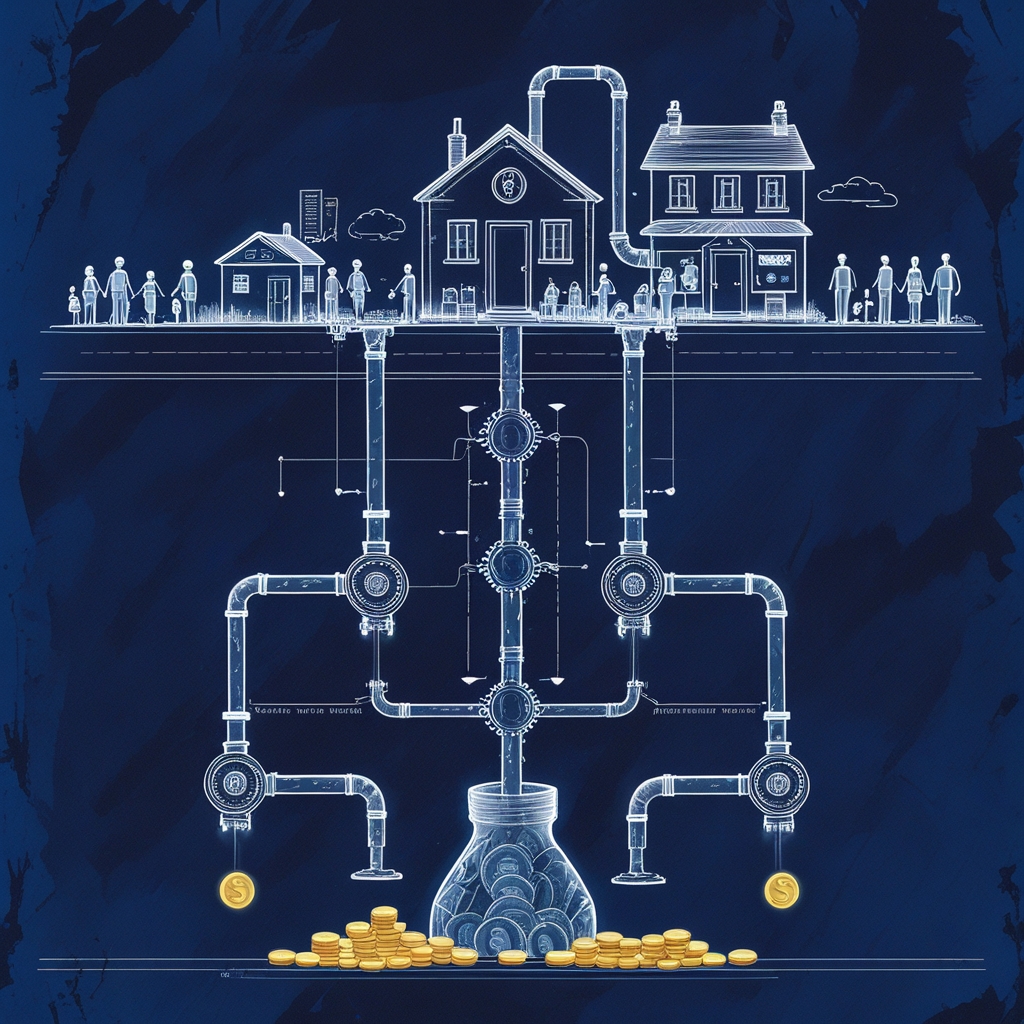
Let me show you how inheritance tax actually works.
The nil-rate band:
Everyone gets a £325,000 allowance, the nil-rate band. Up to this amount, no tax is charged. Above it, 40% is taken. So if your estate is worth £500,000, the first £325,000 is tax-free, and the remaining £175,000 is taxed at 40%, meaning £70,000 goes to HMRC and £430,000 goes to your heirs.
This threshold has been frozen since 2009. Frozen for fifteen years. And during those fifteen years, property prices have risen dramatically. A house worth £250,000 in 2009 is worth £450,000 now in many areas. So families who were comfortably below the threshold in 2009 are now well above it, not because they got wealthier, but because the government froze the threshold while property values inflated.
This is fiscal drag, a stealth tax increase. The government does not raise the rate, it just freezes the threshold and waits for inflation to push more estates into the tax net. And it works. The number of estates paying inheritance tax has doubled since 2009, not because people are dying richer, but because the threshold has not moved while everything else has.
The residence nil-rate band:
In 2017, the government introduced an additional allowance, the residence nil-rate band, which applies when you leave your main home to direct descendants, children or grandchildren. This allowance is £175,000 per person, so a couple can pass on £350,000 of property value tax-free on top of the standard £325,000 each.
So a couple, with the standard nil-rate band of £325,000 each and the residence nil-rate band of £175,000 each, has a combined allowance of £1,000,000. A million pounds. Sounds generous. And for most of the UK, it is. But in London and the South East, where the average house is worth £500,000 to £700,000, and family homes easily exceed £1,000,000, this allowance is insufficient. And above £2,000,000, the residence nil-rate band is tapered away, reduced by £1 for every £2 over the threshold, so the very wealthy lose this relief entirely.
But here is the key: the residence nil-rate band only applies if you leave your home to direct descendants. If you leave it to siblings, to nieces, to nephews, to friends, to charity, you do not get the relief. You get only the standard £325,000. So the system privileges traditional family structures, encourages passing wealth down bloodlines, and penalizes those without children or those who want to leave their estate to anyone else.
Exemptions and reliefs:
Inheritance tax is full of exemptions. Anything left to a spouse or civil partner is tax-free, unlimited, no matter how much. So if you die and leave everything to your spouse, no tax is paid. The tax only arises when the second partner dies and the estate passes to the next generation.
Gifts to charity are tax-free. And if you leave at least 10% of your estate to charity, the tax rate on the rest drops from 40% to 36%. This is a relief designed to encourage charitable giving, but it also allows the wealthy to reduce their tax bill while appearing philanthropic.
Business relief and agricultural relief allow business assets and farmland to be passed on tax-free, as long as the business has been owned for at least two years and is still operating. This is supposed to protect family businesses from being broken up to pay tax, but it is also a massive loophole. The wealthy buy businesses, buy farmland, hold them for two years, and pass them on tax-free. A £10,000,000 farm pays no inheritance tax. A £500,000 house does.
Pensions are outside the estate. If you die before 75, your pension pot can be passed on tax-free to your beneficiaries. If you die after 75, they pay income tax on withdrawals, but no inheritance tax. This makes pensions a powerful inheritance tax planning tool, and the wealthy maximize pension contributions late in life specifically to move assets out of their taxable estate.
Gifts and the seven-year rule:
You can give away assets during your lifetime, and if you survive seven years after making the gift, it is outside your estate and no inheritance tax is charged. This is called a potentially exempt transfer. But if you die within seven years, the gift is added back into your estate and taxed.
There is a taper, if you die between three and seven years after the gift, the tax is reduced on a sliding scale. But if you die within three years, the full 40% applies.
And there are annual exemptions, you can give £3,000 per year to anyone without it counting toward your estate, and unlimited small gifts of £250 to as many people as you want. Gifts to children on marriage are also exempt, up to £5,000 per parent.
But here is the problem with the seven-year rule: it favors the healthy and the young. If you are 85, in poor health, giving away your house in the hope of surviving seven years is a gamble. If you are 50, healthy, wealthy, you can start transferring assets decades before you die, and by the time you die, your estate is minimal and your heirs pay nothing. So the rule privileges those wealthy enough to give away assets early and live off investments or income, and penalizes those who need their assets to live on until they die.
Trusts:
The wealthy use trusts to avoid inheritance tax. A trust is a legal structure where assets are held by trustees for the benefit of beneficiaries, and if structured correctly, the assets are outside the estate of the person who created the trust.
Discretionary trusts, bare trusts, life interest trusts, all serve different purposes, but all can be used to move assets out of an estate while retaining some control or benefit during life. Trusts are complex, require legal advice, cost money to set up and maintain, and are only accessible to those wealthy enough to afford professional estate planning.
So the system creates two classes: ordinary families who own a house, maybe some savings, and pay 40% on anything above £325,000 or £500,000 or £1,000,000 depending on circumstances. And wealthy families who use business relief, agricultural relief, pensions, trusts, and lifetime gifts to pass on millions tax-free.
Property and the crisis:
The majority of estates caught by inheritance tax consist primarily of property. A family home in London, in the South East, in parts of the Midlands, is worth £500,000, £700,000, £1,000,000. The family bought it decades ago for £50,000, lived in it, raised children in it, and now it is worth a fortune. Not because they are wealthy, but because property prices inflated.
And when the parents die, the house, the family home, is valued at current market rates. And if it exceeds the allowances, 40% of the excess is due. The heirs, the children, do not have cash. They inherit a house. And to pay the tax, they must sell the house, because they do not have £100,000 or £200,000 in cash lying around.
So the family home, held for generations, is sold. Not because the family wants to sell, but because the tax bill forces it. And the buyer is often a wealthy investor, a developer, someone with cash, who pays below market value because the sale is forced, is urgent. And the family, having paid the tax, is left with less than they would have received if there were no tax, and the home is gone.
This is not taxation of wealth. This is forced liquidation of family assets. And it transfers property from families to investors, from those who lived in the home to those who buy it as an asset.
The politics:
Inheritance tax is deeply unpopular. Polling shows that 60-70% of people oppose it, across all political affiliations. It is seen as unfair, as taxing the same wealth twice, as punishing those who saved, who worked, who bought a home. And the fact that it falls heavily on middle-class families with one property, while the very wealthy avoid it through reliefs and planning, makes it politically toxic.
But it raises revenue. About £7 billion per year, a small portion of total tax revenue but significant. And it is progressive, in theory, it taxes wealth, it taxes estates, it redistributes. So governments of all parties defend it. Labour defends it ideologically, arguing it is fair and prevents dynastic wealth. Conservatives promise to cut it to win votes, but in power, they keep it, because the Treasury needs the revenue. Both freeze the threshold, both benefit from fiscal drag, and both resist meaningful reform.
But the public does not see it as fair. They see it as punishing aspiration, punishing homeownership, punishing those who saved to pass something on to their children. And the freeze of the nil-rate band, the fiscal drag, the fact that more and more ordinary families are caught while the wealthy escape, fuels the anger.
The outcome:
Inheritance tax is supposed to tax wealth, to prevent the accumulation of dynastic fortunes, to redistribute from rich to poor. But in practice, it taxes the middle, it taxes property, it forces the sale of family homes, and it allows the wealthy to escape through reliefs, exemptions, and planning. It is not a wealth tax. It is a property tax on those not wealthy enough to avoid it.
This is the machine. The structure. The rules. And the next article will show you who profits, who benefits from this system, because while families pay tax and lose homes, someone is gaining.