How Workplace Systems Shape Behavior
You start a new job. You are motivated. You care about doing good work. You have ideas. You want to contribute. And for the first few weeks, maybe even the first few months, that energy holds. You notice inefficiencies and think about how to fix them. You see opportunities and want to pursue them. You believe that effort and competence will be rewarded.
And then, slowly, something shifts. You notice that the things you thought mattered do not seem to matter as much as other things. The metrics you are measured on do not align with the work you think is important. The people who get promoted are not always the ones doing the best work. The ideas you propose get stuck in approval processes that never seem to end. And the culture, which seemed collaborative at first, reveals itself to be more political than you realized.
So you adapt. You stop pushing so hard on the things that do not get rewarded. You start optimizing for the metrics, even when you know the metrics are flawed. You learn which battles are worth fighting and which are not. You become, over time, a different version of yourself. Not because you stopped caring. But because the system shaped you into what it rewards. And what it rewards is rarely what it claims to value.
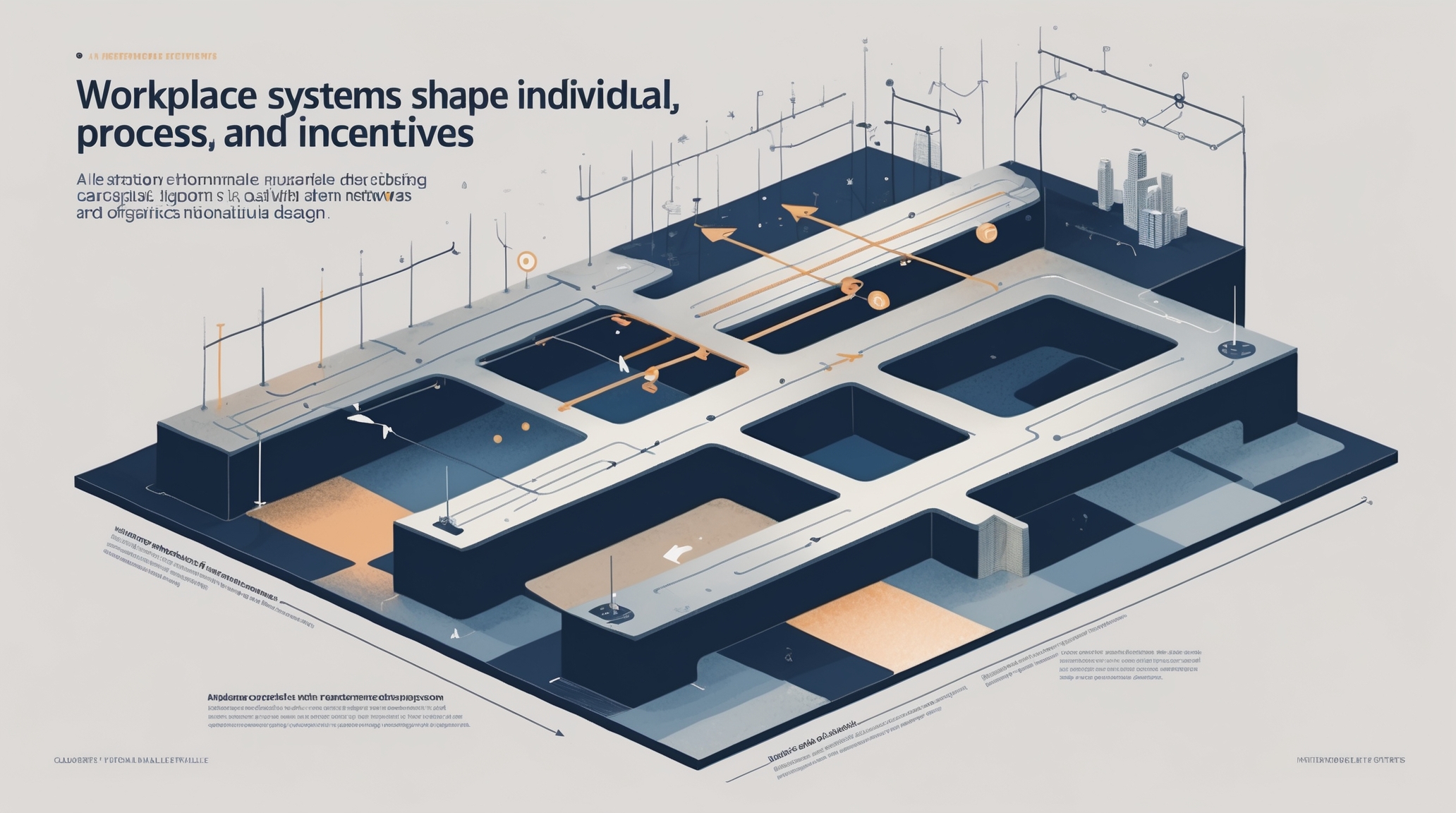
This is not failure. This is structure. Workplaces are systems. And systems shape behavior. Not through intention. Through incentives, constraints, and feedback. And once you see how the shaping works, you stop blaming individuals for outcomes that are structural. Because the system is doing the work. The people inside it are just responding.
Let me show you how workplace systems shape behavior.
The first mechanism is metrics. Every workplace measures something. Sales targets. Productivity numbers. Customer satisfaction scores. Error rates. Time to completion. These metrics are meant to capture performance. But what they actually do is define it. Because people optimize for what gets measured. And if the measurement is flawed, the optimization produces flawed outcomes.
Think about a call center. The metric is call resolution time. The faster you resolve calls, the better your performance. So what do agents do? They resolve calls quickly. Even if that means the problem is not actually solved. Even if it means the customer has to call back. Because calling back does not hurt the agent's metric. Taking longer on the first call does. So the system incentivizes speed over quality. And quality suffers. Not because the agents do not care. But because caring is not what the system rewards.
Or think about a sales team measured on revenue. Not profit. Not customer retention. Revenue. So salespeople sell. They hit targets. They close deals. But some of those deals are not profitable. Some of those customers churn within months. The company is growing revenue but losing money. And the salespeople who created the problem get bonuses. Because they hit their metric. The metric was flawed. But the system optimized for it anyway.
This is the problem with metrics. They reduce complexity to a number. And the number becomes the goal. Even when achieving the number undermines the purpose the metric was supposed to serve. People inside the system see this. They know the metric is broken. But they are not rewarded for pointing it out. They are rewarded for hitting it. So they hit it. And the system produces exactly what it measures, whether that is what it needs or not.
The second mechanism is incentives. And incentives are not just financial. They are social. Reputational. Emotional. What gets you noticed. What gets you promoted. What makes your manager happy. What keeps you safe. These are the real incentives. And they shape behavior far more powerfully than any mission statement.
Think about a company that says it values innovation. But when someone proposes an innovative idea, it gets stuck in layers of approval. Legal has concerns. Finance questions the ROI. The manager does not want to take the risk. So the idea dies. Meanwhile, the person who proposed it learns a lesson. Innovation is not actually rewarded. Safety is. So next time, they do not propose anything risky. They stick to what has been done before. The company wonders why innovation has stalled. But the system is working exactly as designed. It is punishing risk and rewarding conformity. And people, rationally, conform.
Or think about a workplace that claims to value collaboration. But promotions are decided individually. Based on individual performance. Individual achievements. So what do people do? They protect their work. They do not share credit. They compete with colleagues instead of collaborating with them. Because collaboration does not help you get promoted. Standing out does. The system says it values teamwork. But it rewards individual achievement. So individuals optimize for achievement, even at the expense of the team.
This is the gap between stated values and actual incentives. And the gap is where behavior gets shaped. People do not follow the values. They follow the incentives. Because incentives are real. Values are aspirational. And when the two conflict, incentives win.
The third mechanism is structure. The way a workplace is organized determines what is possible. Hierarchies. Reporting lines. Decision-making authority. Information flow. These are not neutral. They enable certain actions and block others. And the people inside the structure adapt to what the structure allows.
Think about a workplace with a deep hierarchy. Every decision has to go through multiple layers of approval. Someone at the bottom has an idea. They propose it to their manager. The manager likes it but has to get approval from their manager. Who has to get approval from their manager. By the time the idea reaches someone with authority to say yes, it has been filtered, adjusted, and softened so much that it barely resembles the original. Or it has taken so long that the opportunity has passed. So the person at the bottom learns. Do not bother proposing ideas. They will not get implemented anyway. The structure has taught them that initiative is futile. So they stop taking it.
Or think about a workplace where information is siloed. Each department has its own data. Its own goals. Its own priorities. And there is no mechanism for sharing. So when a problem arises that requires coordination, it does not get solved. Because no one has the full picture. Each department optimizes for its own goals, unaware that their optimization is creating problems elsewhere. The structure prevents collaboration. Not because people do not want to collaborate. But because the structure does not enable it.
The fourth mechanism is culture. And culture is not what the company says it is. Culture is what behavior gets tolerated. What gets celebrated. What gets punished. And those signals shape how people act far more than any written policy.
Think about a workplace where long hours are celebrated. The person who stays late gets praised. The person who leaves on time gets judged. The official policy might say work-life balance is important. But the culture says otherwise. So people stay late. Not because the work requires it. But because the culture rewards it. And over time, staying late becomes the norm. Not because it is productive. But because it is what gets noticed.
Or think about a workplace where mistakes are punished harshly. Someone makes an error. They are publicly criticized. Maybe demoted. Maybe fired. The message is clear. Do not make mistakes. So people stop taking risks. They do not try new things. They do not experiment. They stick to the safe path. Because the cost of failure is too high. The culture has taught them that safety is more important than innovation. So they optimize for safety. And innovation dies.
Culture is shaped by what leaders do, not what they say. A leader who says they want honest feedback but punishes people who give it is creating a culture of silence. A leader who says they value results but rewards the person who looks busy is creating a culture of performance theatre. The signals people receive are more powerful than the words they hear. And people respond to signals.
The fifth mechanism is information asymmetry. The people at the top have information the people at the bottom do not. And the people at the bottom have information the people at the top do not. This creates a gap. And the gap distorts decision-making.
Leaders make decisions based on reports, summaries, and data. But those reports are filtered. The people creating them know what the leader wants to hear. So they emphasize the positive and downplay the negative. Not out of dishonesty. But out of self-preservation. Because delivering bad news is risky. So the leader operates on incomplete information. They make decisions that seem rational based on what they know. But what they know is not the full picture.
Meanwhile, the people on the ground see problems the leader does not. They see where the process is broken. Where the policy does not work. Where the customer is unhappy. But they do not report it. Because reporting it requires going up the chain. And going up the chain is slow, bureaucratic, and often futile. So they work around the problem instead of fixing it. And the problem persists. Not because it is unsolvable. But because the structure prevents the people who see it from being heard by the people who could fix it.
The sixth mechanism is time pressure. Workplaces operate on deadlines. Quarterly targets. Project milestones. Deliverable dates. And when time is short, quality suffers. Not because people do not care about quality. But because they care about hitting the deadline more. Because missing the deadline has immediate, visible consequences. Delivering low-quality work has delayed, diffuse consequences. So when forced to choose, people choose speed.
This is why corners get cut. Why testing gets skipped. Why processes get rushed. Not because people are lazy. But because the system prioritizes speed. And speed, when prioritized, comes at the expense of everything else.
The seventh mechanism is learned helplessness. When people try to change things and fail repeatedly, they stop trying. Not because they are apathetic. But because they have learned that effort does not lead to results. The system is unresponsive. Proposals get ignored. Feedback disappears into a void. Problems get acknowledged but not fixed. So people stop proposing. Stop giving feedback. Stop trying to fix things. They do their job. They keep their head down. They wait for someone else to care. And because everyone is doing the same thing, nothing changes.
This is not a failure of the individuals. It is a failure of the system to respond. And when systems do not respond, people disengage. Not out of malice. Out of exhaustion.
So here is what you end up with. A workplace full of capable, well-intentioned people producing outcomes no one wants. Not because they are incompetent. But because the system is shaping their behavior in ways that do not align with the organization's goals. The metrics are flawed. The incentives are misaligned. The structure is rigid. The culture punishes honesty. Information flows poorly. Time pressure dominates. And people have learned that trying to change things is futile.
This is not unique to bad workplaces. This is how workplaces work. Even good ones. Even well-managed ones. Because the mechanisms that shape behavior are structural. They are baked into how organizations operate. And unless those structures are deliberately designed to produce the behavior you want, they will produce something else. Something that might look productive on the surface but is dysfunctional underneath.
And here is the uncomfortable part. The people at the top often do not see this. Because they are insulated. They see the reports. They hear the presentations. They attend the meetings where everyone nods and agrees. They do not see the workarounds. The frustrations. The quiet disengagement. The gap between what people say in meetings and what they say to each other afterward. So they think the system is working. And they are baffled when the results do not match expectations.
The people at the bottom see it clearly. But they have learned not to say it. Because saying it does not change anything. It just makes you a problem. So they stay quiet. And the system continues. Shaping behavior. Producing outcomes. And wondering why good people keep failing to deliver.
The next article will show you why the systems you encounter as a customer are designed to frustrate you. Why getting help is hard. Why processes are complicated. Why you feel like you are being deliberately ignored. Because you are not wrong. The system is working exactly as designed. Just not for you.