Why Debt Expands Naturally Inside Modern Systems
A young couple sits across from a mortgage advisor. They have saved for years. They have steady jobs. And now they are looking at houses they could never afford with cash alone. The advisor runs the numbers. With a mortgage, they can borrow five times their annual income. Maybe more. Suddenly, homes that were impossible are within reach.
They are nervous, of course. It is a lot of debt. Decades of repayments. But the advisor reassures them. Property values rise over time. Rents are higher than mortgage payments. Everyone does it. And besides, if they do not buy now, prices will keep climbing and they will be priced out forever.
So they borrow. They sign. They buy. And they are not alone. Across the country, thousands of other couples are doing exactly the same thing. Each one making a rational decision based on the information they have. Each one responding to the same signals. Each one adding to the total stock of debt in the system.
This is not recklessness. This is how the system works. Debt does not expand because people are irresponsible. It expands because the structure makes expansion the logical choice. And once you see how the structure works, the growth of debt stops looking like a moral failing and starts looking like an inevitable feature of the system itself.
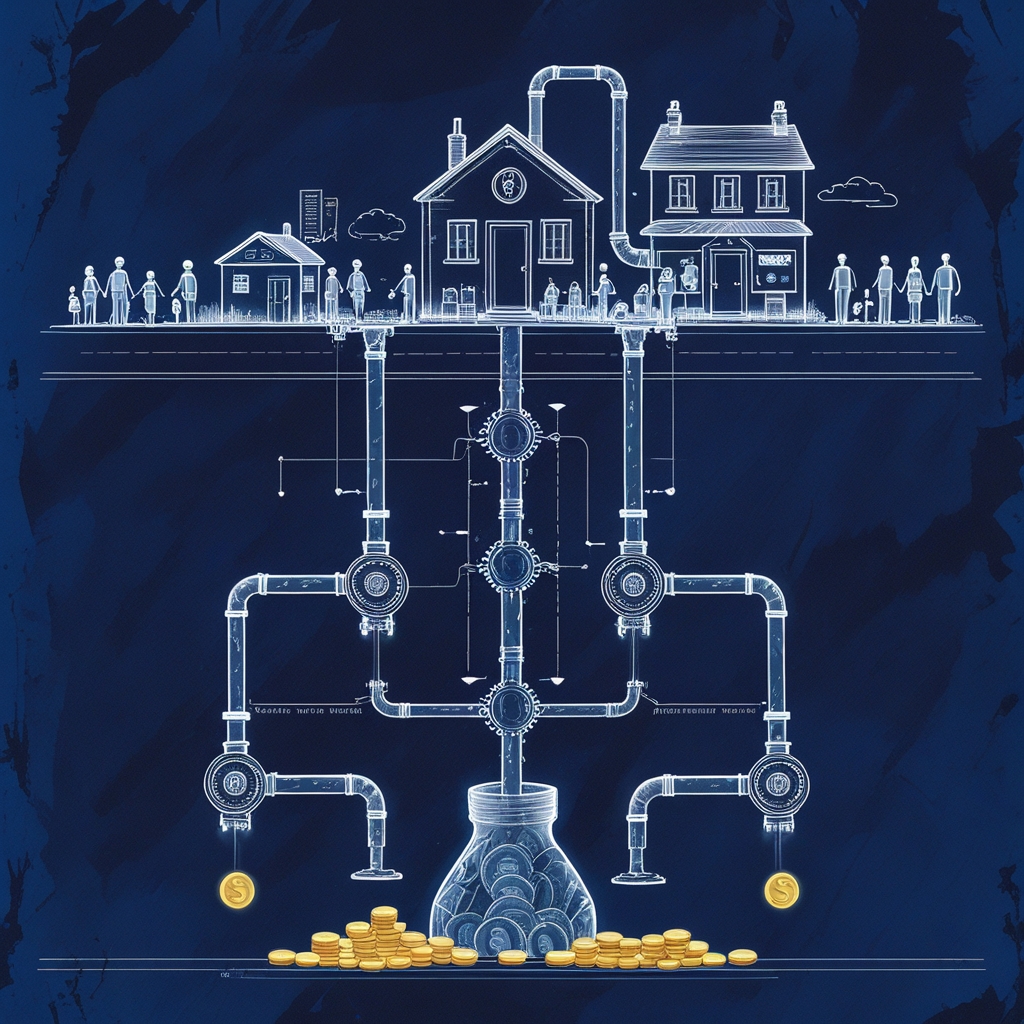
Let me start with the basics. In a modern economy, most money is not created by governments printing notes. It is created by banks making loans. When a bank gives you a mortgage, it does not take money out of a vault and hand it to you. It creates the money by writing the loan into existence. You now owe the bank. And the money you borrowed now exists in the system. This is called credit creation. And it is how the majority of money in circulation comes into being.
Here is what that means. The money supply is not fixed. It expands every time someone borrows. And it contracts every time someone repays. So the size of the money supply is directly tied to the level of debt. More borrowing means more money. More money means more spending. More spending means more economic activity. The system grows by expanding debt.
Now think about the incentives. If you are a bank, your profit comes from lending. The more loans you make, the more interest you earn. So you are incentivised to lend as much as possible, to as many people as possible, at the highest rates the market will bear. You are not incentivised to be cautious. You are incentivised to grow your loan book.
If you are a borrower, you are looking at a world where access to credit allows you to do things you could not otherwise do. Buy a house. Start a business. Go to university. The future benefits feel tangible. The debt feels manageable because it is spread over time. And if everyone around you is borrowing, it feels normal. Safe, even. So you borrow.
If you are a government, you are watching an economy that grows when people spend and stalls when they do not. And spending requires money. If people do not have enough income, they need credit. So you create policies that make borrowing easier. Lower interest rates. Tax relief on mortgage interest. Subsidised loans for students. You are not trying to trap people in debt. You are trying to keep the economy moving. But the effect is the same. Debt expands.
Everyone in the system is responding rationally to the incentives they face. But collectively, those rational responses produce a system where debt grows faster than income. And that creates pressure.
Here is why. Income is limited by productive capacity. You can only earn what you can produce or what someone is willing to pay you. But debt is limited only by willingness to lend and willingness to borrow. And both of those are shaped by confidence, not by productive capacity. So debt can grow much faster than the real economy. And for a while, that feels like prosperity. People are spending. Businesses are growing. Asset prices are rising. Everyone feels wealthier.
But the wealth is not real. It is leveraged. It depends on the debt being repaid. And repayment depends on future income. So the system is betting that tomorrow's income will be high enough to service today's debt. As long as that bet holds, everything works. But if income falters, or if confidence drops, the structure starts to wobble.
Let me give you an example. House prices. In many countries, house prices have risen far faster than incomes over the past few decades. Why? Not because houses got better. Not because there was a sudden shortage of land. But because credit became more available. Banks were willing to lend larger multiples of income. Interest rates fell, so monthly payments stayed affordable even as the total debt grew. And people borrowed as much as they could because they believed prices would keep rising.
Each buyer was making a rational choice. Borrow now, benefit from future price rises. But collectively, all that borrowing pushed prices higher. And higher prices meant the next buyer needed an even bigger loan. Which pushed prices higher still. The system became self-reinforcing. More debt led to higher prices. Higher prices required more debt. And as long as banks kept lending, the loop continued.
But notice what has happened. The debt is real. It has to be repaid. But the price rise was driven by the debt itself, not by any increase in the underlying value of the houses. So the system has created a growing gap between the debt people owe and the income they have to service it. And that gap is a vulnerability.
Here is another pressure point. Debt is not evenly distributed. Some people borrow a lot. Others borrow very little. And the people who borrow the most are often the ones with the least room for error. First-time buyers stretching to get on the property ladder. Small businesses borrowing to cover cash flow gaps. Students taking loans to pay for degrees that may or may not lead to well-paying jobs.
These borrowers are highly sensitive to changes in income or interest rates. If they lose a job, they cannot make the payments. If rates rise, their costs jump and they default. And because they are leveraged, a small change in their circumstances creates a large change in their ability to repay. This is what leverage does. It amplifies. On the way up, it amplifies gains. On the way down, it amplifies losses.
Now scale that across the system. Millions of households. Thousands of businesses. All carrying debt. All sensitive to shifts in income, employment, or interest rates. The system is stable as long as nothing changes. But it is fragile. A shock in one place can cascade. One default leads to another. Confidence drops. Lending tightens. People who were planning to borrow cannot. Spending falls. Incomes fall. More defaults follow. The reinforcing loop that drove expansion now drives contraction. And it moves fast.
This is not a conspiracy. It is not anyone's fault. It is the structure. The system is designed to expand debt because expansion drives growth. But the same mechanisms that enable expansion also create fragility. And the fragility is hidden during good times because everyone is focused on the benefits. It only becomes visible when something breaks.
Here is the part that makes this hard to escape. Once debt is in the system, it cannot just disappear. Someone owes it. Someone is owed it. And both sides of that equation have built their plans around it. The borrower has committed to repayments. The lender has counted on receiving them. If the borrower defaults, the lender takes a loss. If enough borrowers default, the lender fails. And if the lender fails, the people who deposited money with the lender lose access to their funds. The failure spreads.
This is why governments step in during financial crises. Not to reward bad behaviour, but to prevent the cascade. Because in a system where debt is interconnected, one failure triggers others. And if the cascade is not stopped, it takes down the whole system. So governments bail out banks, not because banks deserve it, but because the alternative is systemic collapse.
But here is the cost. Every time the system is bailed out, the lesson learned is that debt is safe. Borrowers believe they will be protected. Lenders believe they will be rescued. So the incentive to be cautious weakens. And the cycle begins again. More lending. More borrowing. More debt. Until the next crisis.
This is what makes debt expansion structural, not moral. It is not that people are greedy or foolish. It is that the system rewards borrowing and punishes caution. It is that growth depends on credit. It is that everyone is responding to the same incentives, and those incentives point in the direction of more debt.
You can see this in household debt. In corporate debt. In government debt. All of them have grown faster than the underlying economy for decades. And all of them are sustained by the belief that future growth will be enough to service them. But that belief is itself dependent on continued borrowing. Stop borrowing, and growth slows. Growth slows, and income falls. Income falls, and debt becomes harder to service. The system needs more debt to function. But more debt makes the system more fragile.
This is the trap. And it is not a trap any individual can escape by being prudent. Because your prudence does not change the structure. If you refuse to borrow, someone else will. And their borrowing will push up prices, making your caution costly. The system punishes those who opt out.
So what does this mean?
It means debt is not optional in a modern economy. It is structural. It is how money is created. It is how growth is financed. It is how individuals access opportunity and how governments fund services. The system is built on it.
But it also means the system is inherently unstable. Because debt-driven growth only works as long as confidence holds. And confidence is fragile. It is shaped by expectations. And expectations can shift faster than the real economy can adjust.
The next article will show you what happens when they do.
When the signals that drove expansion reverse. When confidence breaks. When the structure that made borrowing feel safe suddenly makes it feel catastrophic.
Because that is when you see the system for what it really is.
Not a machine that can be controlled. But a living, breathing organism that swings between euphoria and panic. And the swing is not random.
It is built into the structure.