
• Home
  • Start Here
  • Systems
  • Deep Dives
  • The Question
  • System Watch
  • System Health
  • Toolkit
  • Books
  • Videos
  1. You are here:  
  2. Home
  3. Systems
  4. Financial Systems

Financial Systems

How money functions as signals, why debt expands structurally, how boom-bust cycles are built in, and who benefits from the design.


Money Is a System of Signals, Not Just Currency

You get a letter in the post. Your credit limit has been increased. You did not ask for it. You do not need it. But there it is. Five thousand pounds of available credit where there was none before.

And something shifts. Not immediately. Not consciously. But the possibilities in your mind change. That holiday you were not sure you could afford suddenly feels within reach. The car repair you were putting off becomes less daunting. The gap between what you earn and what you can spend just widened. And you have not received a single extra pound in actual income.


Read more →

Why Debt Expands Naturally Inside Modern Systems

A young couple sits across from a mortgage advisor. They have saved for years. They have steady jobs. And now they are looking at houses they could never afford with cash alone. The advisor runs the numbers. With a mortgage, they can borrow five times their annual income. Maybe more. Suddenly, homes that were impossible are within reach.

They are nervous, of course. It is a lot of debt. Decades of repayments. But the advisor reassures them. Property values rise over time. Rents are higher than mortgage payments. Everyone does it. And besides, if they do not buy now, prices will keep climbing and they will be priced out forever.

Read more →

Why Financial Crises Are Built Into the System

There is a moment, just before everything breaks, when everyone knows something is wrong but nobody knows when it will end.

House prices have been climbing for years. Everyone said they would keep climbing. Banks kept lending. People kept buying. And then, quietly, the rhythm changes. Sales slow. Prices flatten. A few properties sit on the market longer than expected. Nothing dramatic. Just a pause.

Read more →

Who Benefits and Who Pays

There is a moment in every financial crisis when two very different conversations happen at the same time.

In one room, policymakers are deciding which institutions to rescue. Banks that made reckless bets. Funds that over-leveraged. Companies that borrowed beyond their means. The conversation is urgent. If these institutions fail, the argument goes, the entire system collapses. Jobs disappear. Savings evaporate. The economy seizes. So the decision is made. Billions, sometimes trillions, are deployed. The institutions are saved.

Read more →

Why Regulation Always Lags

There is a pattern that repeats after every financial crisis. The wreckage is examined. Investigations are launched. Reports are written. And everyone agrees that this must never happen again. New rules are proposed. Stricter oversight. Tougher penalties. Greater transparency. The regulations are debated, negotiated, and eventually passed. Politicians declare victory. The system, they say, is now safe.

Read more →

  1. Personal Navigation Strategies

Page 1 of 2

  • 1
  • 2

Book Feature

The Blueprint: How Britain's System Really Works and What You Can Do About It

The Blueprint

Why do the same political and economic problems repeat decade after decade? This book reveals the deeper machinery behind Britain’s institutions — the incentives, constraints and feedback loops that quietly shape outcomes.

Once you understand the system, you can finally see where real leverage exists.

Explore the Book →

Book Feature

How Systems Thinking Solves Problems That Keep Coming Back

How Systems Thinking Solves Problems That Keep Coming Back

Many problems return again and again because the underlying system is never examined. This book introduces the practical mindset of systems thinking — a way to see incentives, feedback loops and hidden structures shaping outcomes.

Explore the Book →

How To Map The System

The Toolkit

The Toolkit

Practical methods to map systems, trace incentives, uncover feedback loops, and identify where real leverage exists. Learn how to analyse any system and understand how it truly works.

Explore the Toolkit →

How Money Flows

The Extraction Pattern

The Extraction Pattern

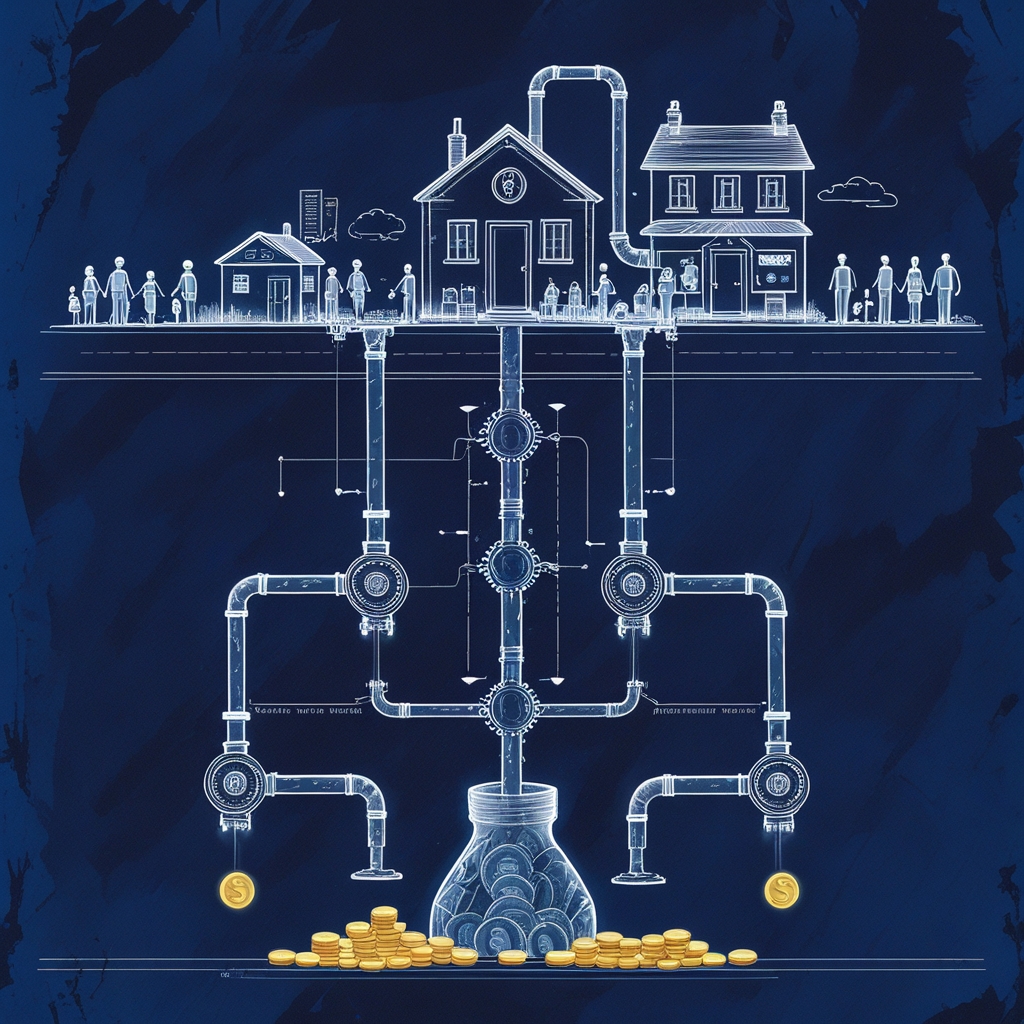
How extraction works across systems — where value is drawn from the many and concentrated toward the few through structure, incentives, and design.

Read the Article →

Books

Explore the Books

  • The Blueprint
  • Understanding Systems Thinking
  • How Systems Thinking Solves Problems That Keep Coming Back
  • The Chain Reaction Effect: Change One Thing, Change Everything
  • Browse Books

Topics

  • Home
  • Start Here
  • Systems
  • Toolkit
  • Fundamentals
  • Deep Dives

Deep Dives

  • The Money System
  • The Customer Service System
  • The UK Housing System
  • The UK Student Loan System
  • The UK Health System
  • The UK Childcare System

Resources

  • Books
  • Videos
  • Toolkit
  • Disclaimer
  • Privacy Policy
  • Contact Us
© 2026 Think On The System | Disclaimer | Privacy Policy