Why Financial Crises Are Built Into the System
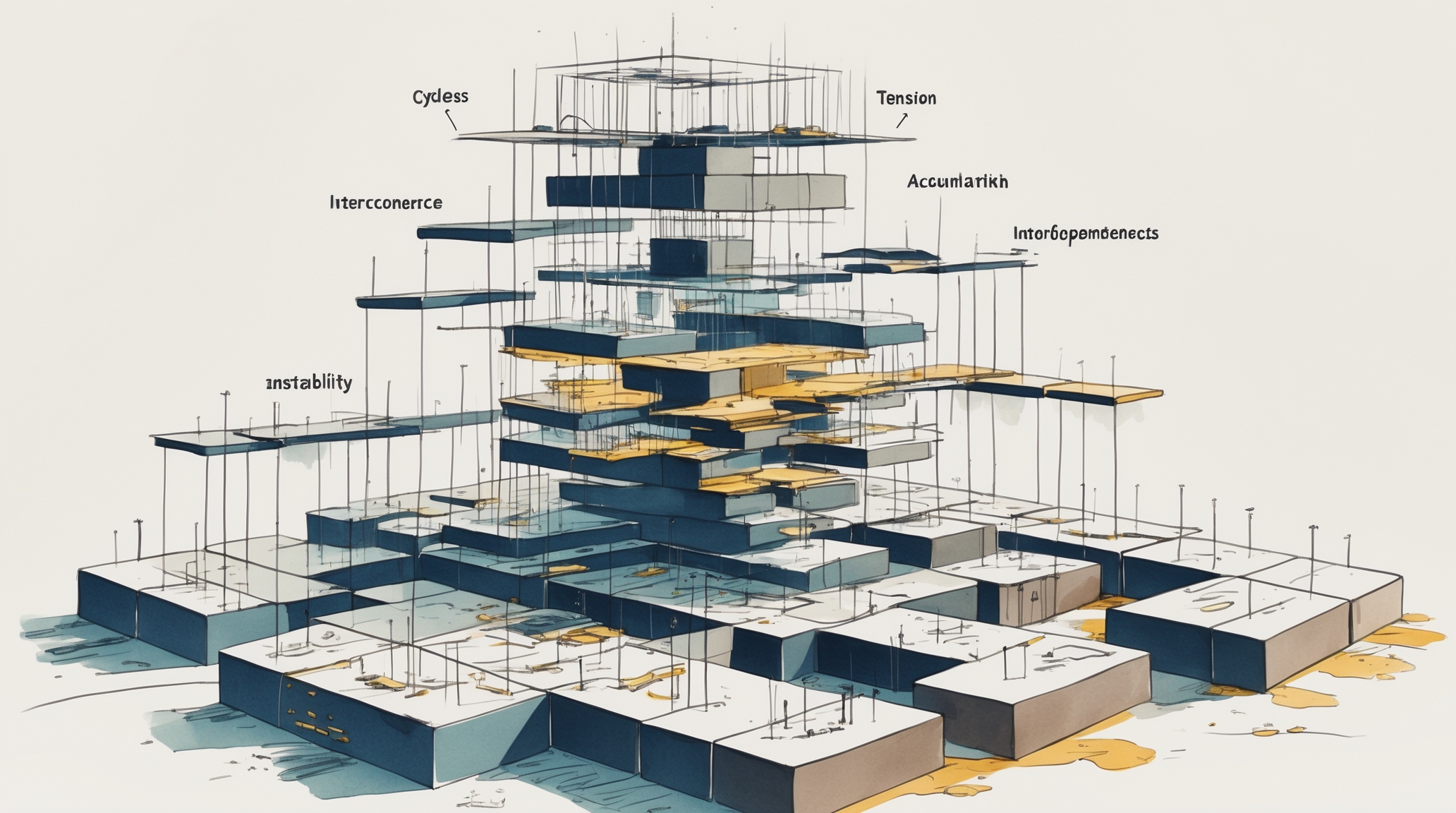
There is a moment, just before everything breaks, when everyone knows something is wrong but nobody knows when it will end.
House prices have been climbing for years. Everyone said they would keep climbing. Banks kept lending. People kept buying. And then, quietly, the rhythm changes. Sales slow. Prices flatten. A few properties sit on the market longer than expected. Nothing dramatic. Just a pause.
But the pause is enough. Because the entire structure was built on the assumption that prices would keep rising. Buyers borrowed as much as they could because they believed the asset would be worth more tomorrow. Lenders gave them the money because they believed the collateral was safe. Investors bought mortgage-backed securities because they believed the income stream was secure. Everyone made decisions based on the same assumption. And the assumption was baked into the price.
Now the assumption is wobbling. And once it wobbles, everything else starts to unravel. Not slowly. Fast.
Buyers pull back. If prices are not rising, why rush? Why stretch? Better to wait. Fewer buyers means more properties on the market. More supply, less demand. Prices start to fall. And once they fall, the buyers who were considering purchasing now definitely wait. The slide accelerates. Sellers panic. They drop prices to get out before it gets worse. But dropping prices signals to everyone else that it is getting worse. So more people try to sell. The market floods. Prices collapse.
And here is the critical part. The debt is still there. The mortgage taken out at the peak does not shrink just because the value of the house has. People now owe more than the asset is worth. They are underwater. Some can still make the payments. But others cannot. Maybe they borrowed at the limit. Maybe their income dropped. Maybe their circumstances changed. They default.
The defaults hit the banks. The banks were holding those mortgages as assets on their balance sheets. Now those assets are worth less. Some are worth nothing. The bank's capital shrinks. And if enough people default, the bank does not have enough capital to cover its obligations. It fails. Or it nearly fails. And the fear that it might fail is enough to trigger a run. Depositors pull their money. Other banks panic. Lending freezes. Credit, which was flowing freely just months ago, disappears.
Now businesses cannot get loans. People cannot refinance. Spending drops. Companies lay off staff. Unemployment rises. Incomes fall. More defaults follow. And the economy, which was growing on the back of rising debt, contracts just as violently in the other direction.
This is a financial crisis. And it is not an accident. It is not caused by a few bad actors or a single reckless decision. It is a structural feature of a system that grows through debt. Because debt-driven growth creates the conditions for its own collapse.
Let me explain why this is inevitable.
The system, as we discussed, expands through borrowing. When confidence is high, people borrow. Borrowing creates money. Money creates spending. Spending creates growth. Growth creates confidence. The loop reinforces itself. And as it reinforces, people borrow more. They take bigger risks. They stretch further. Because everything has been going up, and the assumption is that it will continue.
But growth cannot continue forever at the same pace. Economies are cyclical. Expansion eventually runs into constraints. Maybe there are not enough workers. Maybe wages start rising, squeezing profits. Maybe central banks raise interest rates to cool things down. Whatever the reason, the expansion slows. Not crashes. Just slows.
But the system is not designed for slow. It is designed for expansion. And when expansion slows, the dynamics reverse.
Here is what happens. Asset prices, which were rising because of easy credit and strong demand, stop rising. For people who bought the asset expecting appreciation, this is a problem. Their plan was to sell at a higher price or refinance based on a higher value. Now that plan does not work. They are stuck. Or worse, they are losing money.
Some of them sell. That pushes prices down slightly. Others see prices falling and decide to sell before it gets worse. Now more supply hits the market. Prices fall further. And because prices are falling, people who were thinking of buying pull back. Demand drops. Prices fall faster. The reinforcing loop that drove prices up now drives them down. And it moves faster on the way down than it did on the way up because fear spreads quicker than greed.
Now here is where leverage makes everything worse. Remember, most of the money in the system was created through debt. And debt is a claim on future income. The borrower owes a fixed amount. But the asset backing that debt is not fixed. It fluctuates. And when the asset value falls below the debt value, the borrower is in trouble.
If you borrowed eighty percent of the value of a house, and the house price falls by twenty percent, you now owe more than the house is worth. If you need to sell, you cannot repay the debt. You either default or you find money from somewhere else to cover the gap. And if millions of people are in this position at the same time, defaults spike.
Defaults hit the lenders. Banks and financial institutions were treating those loans as assets. Now those assets are impaired. The bank's balance sheet weakens. And if the bank's capital falls too far, it cannot meet its regulatory requirements. It has to shrink its loan book. That means calling in loans. Refusing new ones. Tightening credit. And when credit tightens, the businesses and individuals who depend on it are suddenly cut off.
This creates a second wave. Businesses that were profitable when they had access to credit are no longer viable when that access disappears. They lay off workers. They close. Unemployment rises. People who lose their jobs cannot make their mortgage payments. More defaults. More pressure on banks. More tightening. The feedback loop spirals.
And now the real economy, not just the financial system, is in trouble. Spending drops because people have less income and less confidence. Companies see falling demand and cut costs further. Investment freezes because nobody wants to commit capital in a declining environment. The economy contracts. And the contraction makes the debt burden heavier because debt does not shrink with the economy. It stays the same size, but incomes are falling. So the ratio of debt to income rises. The system is now over-leveraged, and deleveraging is brutal.
This is why financial crises are so destructive. They are not just market corrections. They are unwinding processes. All the debt that was accumulated during the boom has to be worked off. And working it off means defaults, bankruptcies, foreclosures, unemployment. It means years of slow growth or contraction while the system rebalances.
Here is the part that makes this structural. The boom and the bust are two sides of the same coin. You cannot have one without the other. The mechanisms that enable debt-driven expansion are the same mechanisms that create fragility. Leverage amplifies gains on the way up and losses on the way down. Confidence drives borrowing during good times and hoarding during bad. Interconnection spreads prosperity during expansion and contagion during contraction.
The system is not neutral. It swings. And the swings are built into the design.
Now, you might ask, if this is inevitable, why does it keep happening? Why do people not see it coming? Why do regulators not stop it?
The answer is that people do see it. Some of them. But seeing it does not mean you can act on it. Because acting on it means going against the system. And the system is very good at punishing people who step out early.
If you are a lender and you stop lending during a boom because you think it is getting too risky, you lose market share. Your competitors keep lending. They make profits. You do not. Your shareholders are unhappy. Your job is at risk. So you keep lending, even though you know the risks are building. Because the cost of being cautious is immediate, and the cost of being reckless is delayed.
If you are a borrower and you decide not to buy a house during a boom because you think prices are too high, you watch prices climb further. You watch your friends buy houses that increase in value. You feel like you are missing out. Eventually, you give in. You buy near the top. And then the crash happens. The system punishes caution and rewards risk-taking right up until the moment it reverses. And by then, it is too late.
Regulators face the same problem. During a boom, tightening regulations feels unnecessary. The economy is growing. Employment is high. Asset prices are rising. Everything looks good. If regulators step in and restrict lending, they get blamed for killing growth. So they wait. They let it run. And by the time the risks are obvious, they are too large to contain without causing the very crisis they were trying to prevent.
This is the trap. Everyone can see the risks building. But nobody has the incentive or the authority to stop it. The system rewards those who ride the wave, not those who get off early. And so the wave builds until it breaks.
And when it breaks, the response is always the same. Blame. Regulators blame the banks for reckless lending. Banks blame the borrowers for taking on too much debt. Borrowers blame the system for misleading them. Politicians blame the previous government. Everyone points at someone else. But the truth is simpler. The crisis was not caused by bad people. It was caused by a structure that makes booms and busts inevitable.
Here is what that structure looks like. Debt expands during good times because borrowing is cheap and confidence is high. Asset prices rise because credit is available and demand is strong. Rising prices justify more borrowing because the collateral is worth more. The loop reinforces. Leverage builds. Risk accumulates. And then something shifts. Growth slows. Prices flatten. Confidence cracks. The loop reverses. Deleveraging begins. Prices fall. Defaults rise. Credit contracts. The economy shrinks. And the process of unwinding takes years.
This cycle has played out repeatedly. The nineteen twenties boom and the Great Depression. The nineteen eighties savings and loan crisis. The dot-com bubble. The two thousand eight financial crisis. Each one had different triggers. Different assets. Different players. But the structure was the same. Debt-driven expansion. Over-leverage. Reversal. Collapse.
And each time, after the crisis, there are calls for reform. Stronger regulation. Better oversight. More transparency. And some reforms happen. But the core structure does not change. Because the core structure is what makes the system grow. And nobody wants to dismantle the engine of growth, even if that engine periodically explodes.
So what does this mean for you?
It means financial crises are not aberrations. They are features. They are the system correcting itself after an unsustainable build-up. And they will keep happening as long as the system is designed the way it is.
It means you cannot avoid them by being careful. Because the system is larger than you. You can make prudent decisions. You can avoid excessive leverage. You can save. But if the system crashes, you will feel the effects. Your job might disappear. Your assets might lose value. Your opportunities might narrow. The system does not care about individual prudence. It cares about aggregate behaviour. And aggregate behaviour is shaped by structure.
It also means that blaming individuals misses the point. Yes, some people make reckless decisions. Some institutions behave badly. But they are responding to incentives. And the incentives are set by the structure. Fix the individuals and the structure will produce new ones behaving the same way. Fix the structure, and the behaviour changes.
But fixing the structure is hard. Because it requires accepting that growth will be slower. That returns will be lower. That the party cannot last forever. And that is a message nobody wants to hear during a boom.
So the cycle continues. Expansion. Confidence. Leverage. Reversal. Panic. Collapse. Recovery. And eventually, expansion again.
Not because people are irrational. But because the system is designed to swing.
And the swing, painful as it is, is what keeps the system alive.