Why Attention Becomes the Scarcest Resource
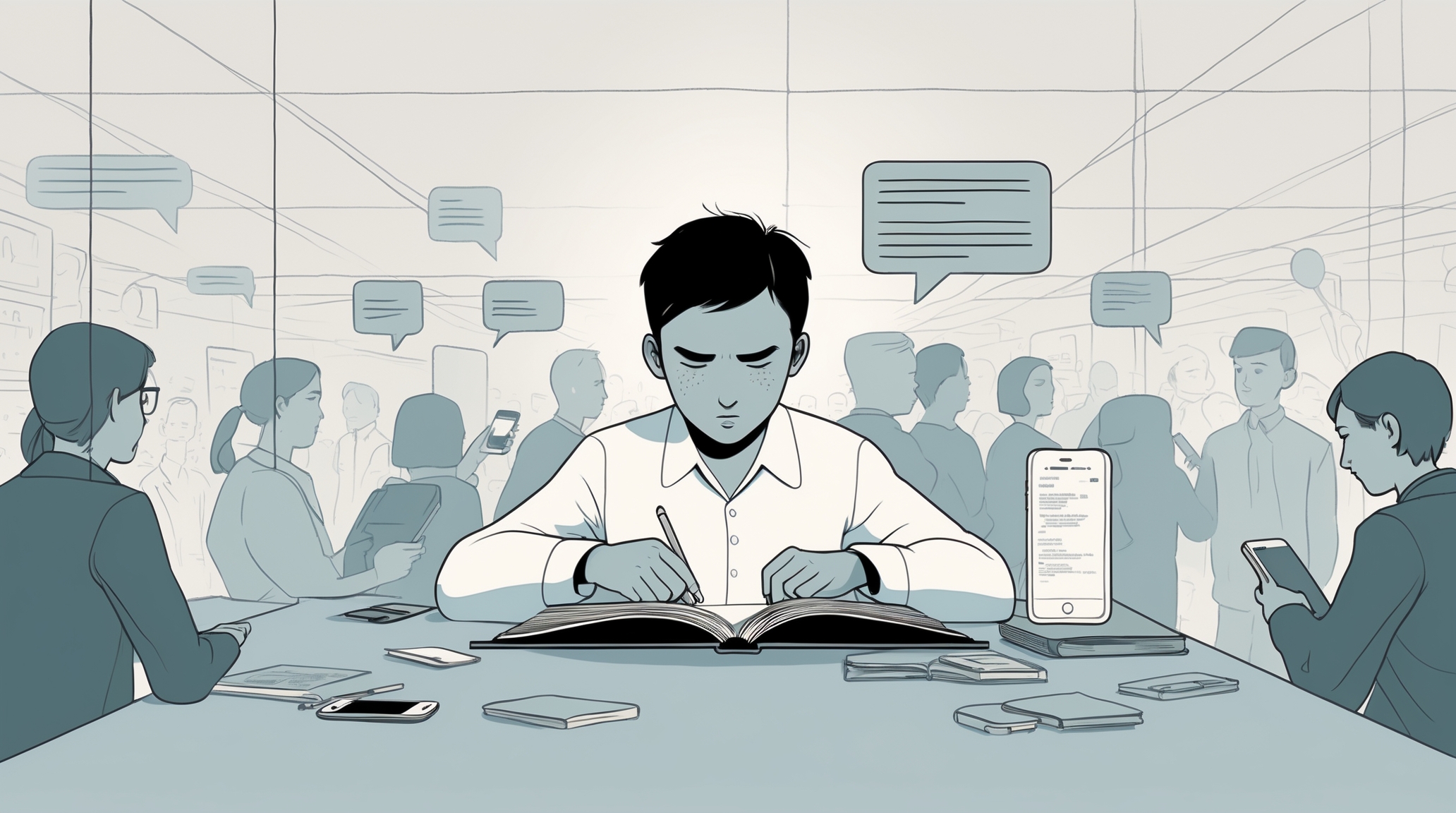
You wake up. Before you are fully conscious, you reach for your phone. Notifications are waiting. Messages. Emails. News alerts. A dozen apps, all demanding that you look. You open one. A headline catches your eye. You click. An ad plays. You skip it. Another article suggests itself. You scroll. A video autoplays. You watch fifteen seconds. You swipe. Another notification arrives. You have been awake for five minutes and already your attention has been sliced into twenty fragments.
This is not an accident. This is design. Because in the modern information economy, attention is not just valuable. It is the resource everything else is built on. And it is scarce.
You only have so many hours in a day. So many moments when you are awake and able to focus. So many seconds when your mind is available to receive information. That capacity is finite. Fixed. It does not grow. But the amount of information competing for it grows every day. Exponentially.
Fifty years ago, there were a handful of television channels. A few newspapers. Radio stations. The information environment was limited. Attention was still finite, but supply was constrained. Today, supply is infinite. Anyone can publish. Anyone can broadcast. Millions of voices. Billions of pieces of content. All of it fighting for the same limited resource. Your attention.
And the fight is not fair. It is not polite. It is ruthless. Because the entire economy of the internet is built on capturing and holding attention. Platforms make money by selling ads. Ads only work if people see them. People only see them if they stay on the platform. So every feature, every algorithm, every design choice is optimised to keep you there. To keep you scrolling. To keep you engaged.
This creates pressure. Enormous pressure. Pressure on everyone who wants to be heard. Content creators. Journalists. Politicians. Activists. Businesses. All of them are competing in the same attention economy. And in that economy, there are winners and losers. The winners are the ones who capture attention. The losers are the ones who do not. And the gap between the two is vast.
Here is what happens when attention becomes the scarcest resource. Everything distorts around it.
First, there is amplification pressure. In a world of infinite content, being quiet means being invisible. So everyone has to be louder. More extreme. More urgent. A measured, calm statement does not break through the noise. A shocking, provocative one does. So the incentive is to amplify. To exaggerate. To make everything sound more dramatic than it is. Not because people are dishonest. But because if you do not amplify, you do not get heard.
Think about news headlines. Fifty years ago, a headline might have been: "Unemployment rises slightly." Today, it is: "Economic disaster looms as jobs crisis deepens." Same information. Different framing. The second one gets clicks. The first one does not. So the second one is what gets published. Not because it is more accurate. But because it is more effective at capturing attention.
This is amplification pressure. And it applies to everything. Political rhetoric gets more extreme because moderate positions do not generate engagement. Arguments get more polarised because nuance does not hold attention. Conflicts get exaggerated because conflict is engaging and resolution is not. The system rewards those who turn the volume up, and punishes those who keep it measured.
Second, there is simplification pressure. Attention is not just scarce in quantity. It is scarce in quality. People are distracted. Tired. Multitasking. They are scrolling while walking, while waiting, while half-watching television. They are not sitting down with full focus, ready to engage with complexity. They are skimming. And skimming requires simplicity.
So content gets simplified. Reduced to the essentials. Stripped of nuance. Complicated issues are turned into binaries. For or against. Good or bad. Us or them. Not because the people creating the content think the world is that simple. But because simplicity is what fits into the attention span that is available.
Think about political debates. Complex policy questions are reduced to soundbites. Thirty seconds. Maybe less. In that time, you cannot explain trade-offs. You cannot acknowledge uncertainty. You cannot present evidence. All you can do is deliver a message that is simple, clear, and emotionally resonant. So that is what politicians do. Not because they are shallow. But because the format demands it. And the format is shaped by attention scarcity.
This is simplification pressure. And it does not just affect politics. It affects journalism. Education. Public discourse. Anything that requires people to pay attention has to compete for that attention by being simpler, faster, easier to consume. And every simplification is a distortion. Because the world is not simple.
Third, there is emotional pressure. Attention follows emotion. This is not a moral judgment. It is a psychological fact. Human beings are wired to notice things that trigger strong feelings. Fear. Anger. Outrage. Joy. Surprise. These emotions capture attention in a way that calm, rational analysis does not. So in an economy where attention is scarce, emotional content wins.
This creates an incentive to make everything emotional. To frame stories in ways that provoke a reaction. To find the angle that will make people feel something. Not because the emotion is relevant to the substance. But because the emotion is what gets attention. And without attention, the substance does not matter because nobody will see it.
Think about social media. A post that says "this is complicated and there are multiple perspectives" gets ignored. A post that says "this is outrageous and you should be angry" gets shared thousands of times. Same topic. Different framing. The second one wins. Not because it is more accurate. But because it triggers the emotional response that makes people engage.
This is emotional pressure. And it skews the information environment toward content that makes people feel strongly, regardless of whether those feelings are justified or helpful.
Now combine all three pressures. Amplification. Simplification. Emotion. What do you get?
You get an information ecosystem where the loudest, simplest, most emotionally charged content rises to the top. Where complexity is invisible. Where nuance is a liability. Where calm, careful, evidence-based analysis is drowned out by headlines designed to provoke. Not because people prefer it that way. But because the structure of the system makes it inevitable.
Here is the feedback loop. Platforms optimise for engagement. Engagement is driven by attention. Attention is captured by content that is amplified, simplified, and emotional. So the algorithm promotes that content. Creators see what the algorithm promotes. They create more of it. The cycle reinforces. And over time, the entire ecosystem shifts toward content that maximises engagement, regardless of its value or accuracy.
This is why your feed feels the way it does. Why everything seems urgent. Why every issue is presented as a crisis. Why every disagreement feels like a battle. Not because the world has become more extreme. But because the information system has become more competitive. And in that competition, the most effective strategy is to be louder, simpler, and more emotional than everyone else.
Here is another effect. Attention scarcity does not just shape what content gets seen. It shapes what content gets created. If you are a journalist, a writer, a researcher, you know that the work you produce will only matter if people see it. And people will only see it if it breaks through the noise. So you face a choice. Do you produce the work that is most rigorous, most accurate, most thoughtful? Or do you produce the work that is most likely to get attention?
For some people, those two things align. But for many, they do not. The most rigorous work is often slow, careful, hedged with caveats. It does not make good headlines. It does not go viral. So it does not get funded. It does not get read. And over time, the people who produce it are pushed out. They cannot compete. The system does not reward them.
What does get rewarded? Speed. Confidence. Certainty. Hot takes. Strong opinions. Content that can be consumed quickly and shared easily. So that is what gets produced. Not because it is better. But because it survives.
This is a selection pressure. Just like in biological evolution, the traits that help an organism survive are the ones that get passed on. In the information ecosystem, the content that captures attention is the content that survives. And the content that does not, dies.
Now think about what this does to knowledge. To understanding. To truth. If the system rewards content that is engaging over content that is accurate, what happens to accuracy? It does not disappear entirely. But it becomes less visible. Harder to find. Drowned out by the noise.
And here is the cruel part. The people who need accurate information the most are often the ones least equipped to find it. Because finding it requires effort. It requires scepticism. It requires the ability to resist the pull of emotionally engaging content and seek out the boring, careful, evidence-based work that does not go viral. Most people do not have the time, the training, or the energy to do that. So they rely on what the system surfaces. And what the system surfaces is what captures attention, not what is most true.
This creates an information asymmetry. A gap between what people believe and what is actually known. And that gap widens as attention becomes scarcer. Because the scarcity creates fiercer competition. And fiercer competition creates stronger distortion.
Here is what this means for you. You are living in an environment where almost everything demanding your attention is doing so because it has been optimised to capture it. The headlines you see. The videos that autoplay. The notifications that interrupt you. None of them are neutral. All of them are designed. And the design is not optimised for your well-being, your understanding, or your ability to make informed decisions. It is optimised for engagement.
So what do you do?
You become conscious of the pressure. You recognise that the information competing for your attention is not competing on the basis of quality or truth. It is competing on the basis of engagement. And engagement is driven by amplification, simplification, and emotion.
You slow down. You resist the pressure to consume quickly. You ask not just what is being said, but why it is being said in this way. Who benefits from this framing? What is being left out? What complexity is being erased by the simplification?
And you choose where you direct your attention. Because attention is not just something that gets taken from you. It is something you give. And in a system where it is the scarcest resource, who you give it to matters.
The next article will show you why regaining that attention is so hard. Why once a narrative takes hold, corrections do not catch up. Why the system resists truth even when truth is available.
Because the machinery that captures attention is also the machinery that prevents correction.
And that is the part most people never see.