The Administrative Machine
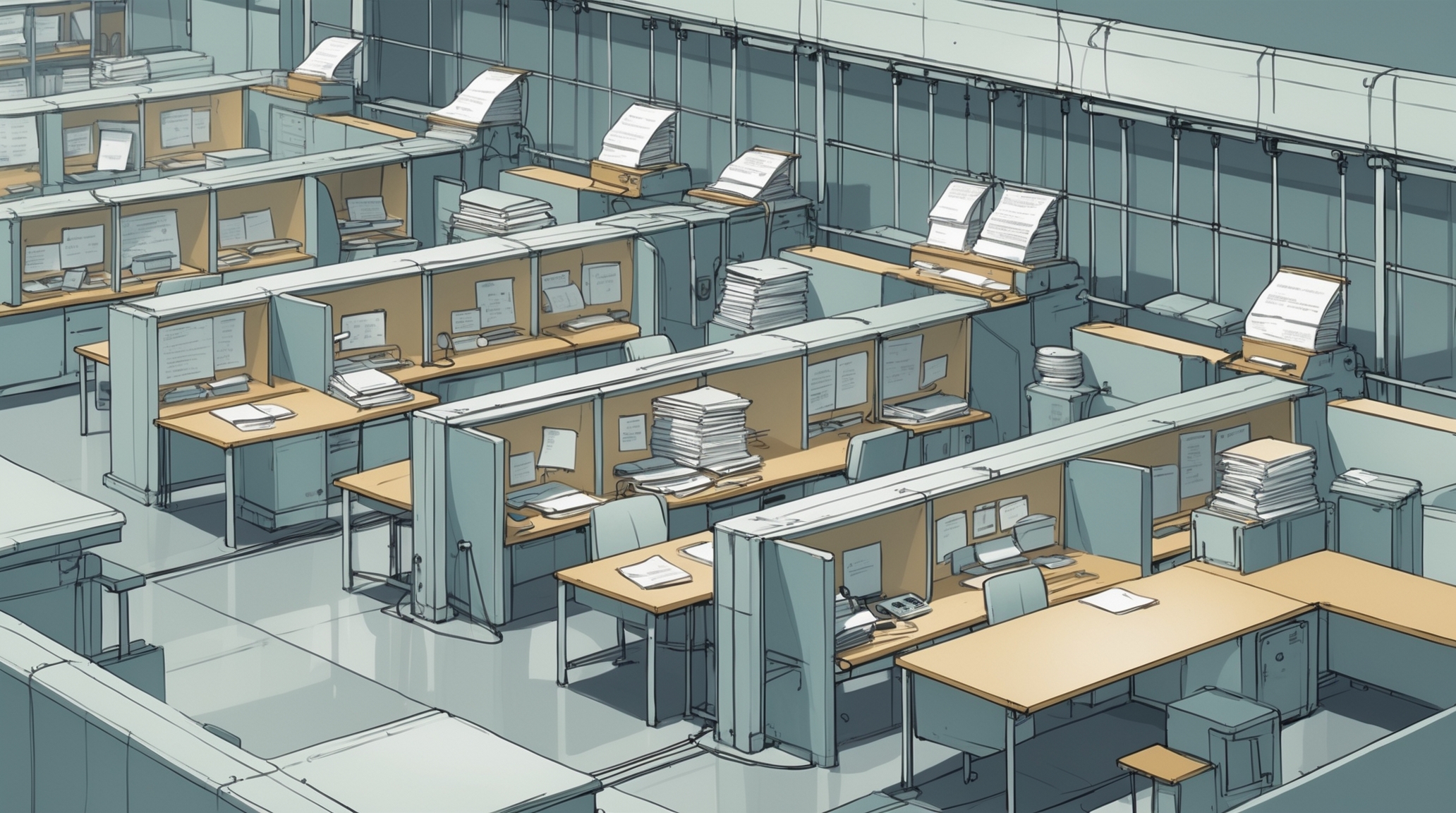
You need a permit. It is not a complicated request. You have filled in the forms. You have provided the documents. Everything is in order. So you submit it and wait.
Weeks pass. Nothing happens. You call to check. The person on the phone tells you your application is being processed. You wait longer. Eventually, you get a letter. Not a decision. A request for more information. Something minor. Something that could have been asked for on day one. So you provide it. And you wait again.
More weeks pass. You call again. This time you are told your application has been passed to a different department. Nobody can tell you why. Nobody can tell you when you will get an answer. You ask to speak to someone who can make a decision. You are told there is a process. The process must be followed.
Finally, months later, you get your permit. Or you do not. Either way, by the time it arrives, the reason you needed it feels like it was from a different life.
This is bureaucracy. And if you have ever dealt with it, you know the frustration. The slowness. The inefficiency. The sense that nobody cares, nobody is in charge, and the whole thing exists just to make your life harder.
But here is the thing. Bureaucracy is not slow because the people in it are lazy. It is not inefficient because they do not care. It behaves the way it does because it is a system. And like all systems, it is optimised for something. Just not the thing you think.
Most people assume bureaucracy exists to get things done. To process applications. To deliver services. To solve problems. And on paper, that is true. But in practice, bureaucracy is not optimised for outcomes. It is optimised for survival.
Let me explain. A bureaucracy is not a single decision-maker. It is a network of roles, rules, and procedures. Each person inside it has a narrow job. Each job has a specific set of responsibilities. And each responsibility is governed by rules that define what is allowed and what is not. Nobody in the system has the full picture. Nobody has the authority to override the rules. And nobody is rewarded for solving your problem quickly. They are rewarded for not making a mistake.
That last part is critical. The primary incentive in most bureaucracies is risk avoidance. Do not approve something that might later be questioned. Do not make a decision that might be wrong. Do not take responsibility for anything that could blow back on you. The safest option is always to delay, refer upward, or ask for more information. Because if you do nothing, you cannot be blamed. But if you do something and it goes wrong, you are the one who will be held accountable.
So what happens? People follow the process. Not because the process makes sense, but because the process protects them. If something goes wrong and you followed the process, you are covered. If something goes wrong and you did not, you are exposed. The system is not designed to reward good judgment. It is designed to punish deviation.
Think about the person processing your permit application. They do not know you. They do not know why your request is urgent. They do not know the context. All they know is that there is a checklist, and their job is to make sure every box is ticked. If one piece of information is missing, they cannot approve it. It does not matter that the missing information is trivial. It does not matter that approving it anyway would be the sensible thing to do. Their job is not to use judgment. Their job is to follow the rules.
And the rules exist for a reason. Or at least they used to. Many of them were created in response to something that went wrong in the past. A scandal. A mistake. A case where someone cut corners and it caused a problem. So a new rule was added to prevent it from happening again. Then another rule. Then another. Over time, the rules accumulate. They layer on top of each other. And nobody ever removes them because removing a rule feels risky. What if the problem it was designed to prevent comes back?
So the bureaucracy gets slower. More complex. More defensive. And the people inside it are not making it that way on purpose. They are just responding to the incentives they have been given. Do not take risks. Do not make mistakes. Follow the process. Survive.
Here is another layer. Bureaucracies are designed to be fair. That sounds like a good thing, and in theory it is. Fairness means everyone is treated the same. The same rules. The same process. No special treatment. No favouritism. But fairness in a bureaucracy does not mean treating people according to their circumstances. It means treating everyone identically, regardless of context.
So if the rules say you need three documents, everyone needs three documents. Even if your situation only requires two. Even if the third document is irrelevant to your case. Because the moment you start making exceptions, you open the door to accusations of bias. Someone will ask why their case was treated differently. Someone will complain. So the safest option is to apply the rules uniformly, even when it makes no sense.
This is why bureaucracies feel so impersonal. It is not that the people in them do not care. It is that the system does not allow them to care. Caring means using discretion. Discretion means deviating from the rules. And deviating from the rules means risk. So caring becomes a liability.
Now think about how decisions get made in a bureaucracy. In a normal organisation, if you need a decision, you go to the person with authority and they decide. But in a bureaucracy, authority is fragmented. No single person has the power to make a decision on their own. Decisions have to be approved at multiple levels. Each level checks that the previous level followed the rules. Each level adds delay. And at every stage, there is an incentive to refer the decision upward rather than take responsibility for it yourself.
So applications move slowly through the system, not because anyone is actively blocking them, but because nobody has the authority or the incentive to move them quickly. The system is designed to diffuse responsibility, and diffusing responsibility means diffusing action.
Here is where it gets even more interesting. Bureaucracies do not just resist change. They actively undermine it. Not out of malice, but out of structure.
Imagine a new policy is introduced. The government wants to simplify the process for getting permits. Reduce the paperwork. Speed things up. Make it easier for people. The intention is good. The instruction is clear. But then the policy has to be implemented by the bureaucracy.
And the bureaucracy does what bureaucracies do. It interprets the new policy through the lens of the old rules. It looks for ways the new policy might create risk. It identifies edge cases where something could go wrong. It adds safeguards. It creates new forms to replace the old ones. It writes guidance documents to clarify the new process. And by the time the bureaucracy has finished implementing the simplification, the process is just as complicated as before. Sometimes more so.
This is not sabotage. It is self-preservation. The bureaucracy is protecting itself from the consequences of change. Because change creates uncertainty. Uncertainty creates risk. And risk is what the system is designed to avoid.
There is also the problem of silos. Bureaucracies are divided into departments. Each department has its own rules, its own priorities, its own budget. And there is very little communication between them. So if your application needs to be processed by three different departments, it moves sequentially. Department A finishes. Then it goes to Department B. Then to Department C. Each one processes it independently, with no coordination. And if Department C discovers a problem, it goes back to Department A, and the whole cycle starts again.
Nobody designed it this way on purpose. It evolved. Each department was created to handle a specific function. Each one developed its own procedures. And over time, the system became fragmented. Now, even when everyone inside it can see that the fragmentation is inefficient, nobody has the authority to fix it. Because fixing it would require changing how multiple departments operate. And changing how departments operate requires approval from people who are not inside the system and do not understand how it works.
So the system stays stuck. Not because people do not want it to improve. But because the structure makes improvement almost impossible.
Here is the uncomfortable truth. Bureaucracies are not broken. They are working exactly as they are designed to work. They are optimised for risk avoidance, procedural compliance, and self-preservation. The problem is that those goals are not the same as efficiency, responsiveness, or problem-solving. And when there is a conflict between following the process and achieving the outcome, the process wins. Every time.
So what does this mean for you, as someone trying to navigate a bureaucracy or understand why it behaves the way it does?
It means you have to stop expecting it to act like a rational decision-maker. It is not. It is a system responding to incentives that are often invisible to the people it serves. The person you are dealing with is not the enemy. They are just a node in a network that rewards caution and punishes initiative.
It means you have to work with the system, not against it. Provide exactly what is asked for. Follow the process precisely. Do not expect flexibility or common sense. The system does not have those. What it has is rules. And the fastest way through is to comply with them completely, even when they seem pointless.
And if you are inside a bureaucracy, trying to make it work better, the lesson is even harder. You cannot change the system by working harder or caring more. You have to change the incentives. You have to make it safer to use judgment than to follow the rules blindly. You have to reward outcomes, not just compliance. And you have to remove the layers of approval that turn every decision into a negotiation.
But that kind of change is difficult. Because the people who have the power to change the incentives are rarely the people who feel the consequences of the current ones. And the people who feel the consequences rarely have the power to change them.
So the bureaucracy continues. Slow. Defensive. Self-preserving. Not because anyone wants it that way. But because that is what the structure produces.
And until the structure changes, the behaviour will not.